Sunday, January 17, 2021

Burnout or Seeing the Light

When I think back to when I was doing my MBA, I was working full-time at a job that was pretty demanding and going to school full-time technically even though it was just in the evenings and on the weekends and doing a lot of class work in between. I can't imagine now trying to do that same thing, that grueling work-school-sleep cycle. Now when I get home from work I can barely do anything but watch TV and sometimes make dinner for myself. I'd

like to work out. I'd like to write. I'd like to do other things. But I can't seem to bring myself to do those things until the weekend, usually on Sunday, after decompressing from the work week with a lazy Saturday. I used to hike! I kind of hated it, but I loved the bragging rights and the pictures from my hikes.

I think part of the problem was that I had time to relax when I was done with school. I gave myself that time after my MBA to figure out what I wanted to do. And, the time just filled itself with less and less desire to be productive. More recently, I went on a 16-day cruise through the Panama Canal. I knew that I was lucky having had the opportunity to not have to work for that period of time and having plenty of money to do it. I enjoyed my cruise so much, I can't fathom not doing it. But now, all I want to do is return to that cruise and return to that balcony and that miniature life system. Life was so simple on the cruise ship; we knew what we liked and we didn't typically want to go out to the finer dining establishments so we basically just went down to the buffet whenever we were hungry. Jaiman could sleep in and that was okay with me. I would either go for a run, go for a swim or just sit outside on our balcony and read. I enjoyed my mornings. And then when Jaiman got up, we could watch TV, we could go explore on shore if we were docked, or play trivia downstairs, and we would enjoy ourselves and then come back to the room and return to napping, watching TV, reading or whatever else we wanted to do. Even during that time when I was preparing to come back to work I was enjoying myself because I had that leisurely time to sit and think and prepare myself. Now that I'm back at work for what I was preparing for, I wish I just had that time back. I can't wait for the day to retire and be able to sleep in, read, exercise without a time limit and be able to do whatever I want to do. It's almost as if I hadn't taken that vacation, I would be in a better state. Having had that vacation now and knowing what I'm missing out on by working all the time I'm now wishing that I had that instead.

My weight has been on an increasing trajectory for years, even with various levels of effort and different initiatives and focuses to get healthy - I will often lose some small but not insignificant amount of weight, 10 or 15 pounds, and then gain it back and then some when I'm "over" the effort. Such that I am worse off now, even exercising and eating marginally well, then when I was gorging myself two years ago, and that was worse then five years ago, etc. In part, I chock it up to my work stress translating to stress eating, not wanting to exercise, and not having sufficient time to make healthier choices. But of course, I wasn't exactly losing weight on the cruise, which was the closest approximation I have to a utopian experience, because I literally had a buffet of every kind of cuisine to choose from, and even when I ate salads and nutritional foods, I supplemented them with pizza and ice cream and whatever else tempted me that day. Even when we did go to the fancier restaurants, whether they were the included or upcharge ones, we didn't eat less, just more of it with less variety.

I struggle, then, with what it is I really want out of life. I often fantasize over ways to make exercise easier, more ingrained as part of my daily life instead of a separate chore to fuss over, and likewise how to make it easier to eat healthy so that I do it more often. But I think the underlying desire is really just that I want to be healthy (read: thin, not like a size 0 but like a size 8), and I don't want to have to stick to any routine or any particular diet, because I know those fail. More broadly, I think I like having a purpose at work, and I think I enjoy the work, i.e. the problem solving and designing of new solutions and analyzing data, but I dread going to work each day. So it begs the question, if I enjoy what I do, then why don't I spring out of bed to go do it every day? I know I hate the politics and unreasonable demands of my boss and the stupidity I sometimes have to crush. But are those the things that make work so dreadful? Or are those just the worst parts that come to mind? Is it the hours? The endless meetings? What makes work suck?

I sometimes contemplate, without success, what I will do when I am retired, and imagine my retirement coming sooner than later, i.e. age 45 rather than in my 60's. That's just 9 years away at this point, although I still feel like I'm in my 20's sometimes. I put myself on that cruise ship and recall the simple pleasure of reading on the balcony and sleeping in til 7 or so. If I had the money to stop working now and live comfortably for the rest of my life, what would I do a month from now? I mean, obviously, I would have to decompress for some time after I leave my last job. But then what? I would travel frequently, but I couldn't travel all the time, that's too expensive and frankly, exhausting. I would read and write, surely. Would I go back to school? That sounds exhausting. Would I try teaching more? Also a lot of work. Would I melt into my couch until I become one with it and watch TV like a vegetable for the rest of my life? Maybe - and that doesn't sound like what I really want.

I guess the real issue is that it feels like I've lost the motivation and drive I once had. Is that old age? Or is this what people refer to as burnout? How can I be burnt out if I haven't done a shit-ton of stuff outside of work in years? Not to mention, I don't even have kids, with their schedules and needs and demands to contend with.

I may have found the answer, or at least a path towards the answer, in an audiobook I'm listening to simply titled, "Rest" by Alex Soojung-Kim Pang. The premise of the book is that rest isn't just something we have to do to avoid burnout, but that rest can be strategically designed to allow our creative juices and production flow more easily. Rest, in this definition,
is not just sleep or unwinding on the couch (actually, the latter may be the worst kind of rest), it is anything outside of work and necessary chores. Thus, it does encompass sleeping, as well as napping, but it also could be taking long walks, strenuous exercise or even creative endeavors unrelated to one's work (for example, a scientist painting or a doctor writing a novel). The book also emphasizes how many great minds and people in the top of their fields wake early and do much of their great work first thing in the morning - when their minds are freshest and before the world starts to bother them. There's a great deal of info about the circadian rhythms and how that affects different types of thinking and awareness.

I've know since seemingly forever that I'm a morning person, which seems rare in our society, and yet perhaps part of my issue is that I've not figured out how to use my early start time to my benefit. Lately, I've been using my morning primarily to exercise, because I lack motivation to do so when I come home from work and I know I won't reliably do it if I put it off until the evening. And, to be fair, I do find the walking helps me think through my day and my priorities, which are helpful, and the running helps me burn off stress and re-center myself. But another thing I'm not doing is as much these days is all the creative stuff I used to do - painting, designing / decorating, creating fabric designs for my small business, and, well, writing. I love writing, and I often use it to think through issues, but lately, even if I've started writing something, I haven't finished it, and don't see the point in publishing something unfinished. In fact, I started this post in October 2020. Some mornings, I do wake up with the intention of sitting down to write, and then I start thinking about my budget or work on my taxes and go down rabbit holes. The "Rest" praises having a routine, and that the routine helps your brain to know when it's time to switch into the appropriate gears so that you don't get distracted. I suck at routines, but a lot of this book makes sense.

So I've been working through what my ideal routine would be - now while working and also once retired. If I want to do more writing and other creative things, I think I really need to focus on doing those in the morning when I'm fresh. My rationale is that a workout is mostly going through the motions - once you're in it, it kind of flows, but creative efforts require the fresh mind. However, that begs (or screams) the question, how do I then ensure I'm exercising regularly? I may sound naïve in this thinking, but I do expect this will be easier when retired, because I'll have more of my day to myself, even if I'm working vigorously on pet projects or income-making activities.

The biggest struggle I have is the hours I'm at work - obviously my work is important because it is what provides the income that allows me to live comfortably, travel regularly and enjoy nice things. And I don't foresee industry as a whole moving to a 4-hour workday anytime soon, even though countless studies show that workers are only productive for part of their 8-hour (or 12-hour) days. Indeed, even when I look at minimizing the time I spend at work, whenever I work over 8-hours it does seem to be a productive use of my time. That leads me to believe I have unproductive uses of my time elsewhere, but when I'm trying to manage my calendar and priorities as well as I can, I just don't see a way to eliminate anything. Then I drive home (or if working from home, close my laptop and take a breath), and I'm completely exhausted mentally, and exercise seems like an insurmountable aspiration.

But it hasn't always seemed like that. When I was working at Henkel in Scottsdale, they had a gym in the building. I'd bring my workout clothes and head to the gym after my workday was over, before toiling in the exhausting commute home. Not having to fight traffic before working out, I think, contributed to the success of this routine for me, and also the fact that it had a nice view and I usually had the place to myself or shared it with one or two other colleagues at most. In a way, it was the same kind of escape for me as my morning exercise has been at other times in my life - a lone pursuit with a great view. There was also the additional incentive that traffic would be better the later I left work, so by spending more time in the building - exercising, not working - I'd have an easier time getting home.

When Jaiman and I moved to Connecticut with Henkel, there was a gym at my workplace there as well, but only for employees (i.e. Jaiman couldn't come), and we had a gym in our apartment building. That and the fact that I walked the very short distance to work and back instead of contending with traffic, led to us often working out after work. Again, we usually had the place to ourselves or with only a couple other people around. It didn't have a nice view, but they did have TVs in the gym that were connected to headphone jacks on the treadmills so you could listen in and even control the channels. I liked that gym, and I spent a lot of time on the treadmill listening to my audiobooks (especially since I didn't have a commute to listen to them on).

All this to say, I guess I don't know the answer. If I spend my morning burst of energy on writing and creative pursuits, perhaps I end up getting more of those accomplished, which is what I want, but at the peril of losing my workout routine. Even if I can limit my work hours as much as possible (which for me would be 7:30 to 4:30 at best), that still gets me home around 5, at which time I want to eat dinner and never move again until it's time to go to bed. Since my company doesn't have an on-site gym, I could sign up for a gym that I would drive to and at least then feel the pressure to do my workout before going home. Maybe I'm just making excuses, but I really loathe the idea of paying for a gym when I can have a sufficient workout for free at home (and in a beautiful setting if I walk or run through the park).

I also think about how I should take walks at work, even just walking to the other side of the campus and back would be a good mental break for me and add some steps in my otherwise pretty stationary day. It has only gotten worse with the latest upswing in COVID, we've made just about all of our meetings virtual, which means I'm not even walking to a conference room down the hall or to the next building over anymore; I'm taking all calls at my desk and using the bathroom five feet away and getting water from the dispenser five feet away, taking my lunch at my desk with my own refrigerator (and the microwave is where the water is) and never leaving a ten foot circumference the entire day. So a walk around lunchtime sounds like a reasonable, positive thing to add  to my work day, and yet, I struggle to make or find the time for even that.

I think, as much as I suck at it, it comes down to making a routine and sticking to it. Coming home, I need to change into my workout clothes and just immediately going into workout mode. That would free up my time in the mornings for writing, painting and designing. I also need to limit the distractions on my phone and perhaps use my phone to start spurring the ideas for me to work on instead.

This morning, I focused on my writing instead of my workout, and now need to make sure I do my workout later today. It makes a lot of sense, but will require some effort and getting use to the new routine.

Saturday, January 9, 2021

Trump's Legacy

I am blessed with a mix of friends (and facebook friends, specifically) whom do not all share the same views as me or each other. I believe it is important to seek to understand opposing positions and viewpoints, and that dismissing people, blocking or unfriending people, starting fights and name-calling are all destructive and divisive. That's not to say that I condemn anyone who has taken those actions themselves; we each do what we think we should do and what we are compelled to do for our own sanity and positivity. For some, that has meant unfriending, or blocking, or even removing themselves from social media. I practice and advocate for limiting social media use, and have a timer on my facebook, among other methods, to limit it in my own life and still be able to share and enjoy the things that made social media attractive in the first place. 

All that being said, I have really struggled to understand people who continue to make excuses for Trump, to side with him and even to repeat his lies about election fraud and COVID conspiracies, etc. In an effort to try to understand, I have spent time reading their arguments and doing my own research. I've taken one lengthy rant from a friend that has a lot of meat to it, because I think this is a helpful insight for me and for other anti-Trumpers to hear and to understand. But also, perhaps my research and my opinions and insights can help Trump supporters understand what makes me and so many others oppose Trump so strongly as well. I did my best in the time I allotted to find credible sources of truth to dispute and to support these selling points for Trump. And, I also share my viewpoint from what I have read and learned.

First, here is the Trump supporter's commentary, unmodified:

"For the bad people may cite, this President brought tax relief to my family, helped close so many Planned Parenthood abortion clinics I can’t even imagine the number of lives that have been saved. He brought illegal immigration to 5% of what it was, lowered unemployment for all people groups and ethnicities, attended prayer meetings with pastors, appointed SCOTUS justices that uphold the sanctity of life. He move the US embassy to Jerusalem and supported Israel to see the best peace they have had in many decades. He actually reduced coal usage and even though people want to blame him for Covid deaths, never has more assistance been given by an Administration to see therapeutics and vaccines developed and delivered in response to a respiratory disease.


"He also restored due process to the prosecution of accusations.
"For all the bad people see, and as so many are firm of upholding that this election has no shenanigans, he single-handedly brought more people to the voting booth than ever in history.


"In addition to my reply in your own post, I will add that Trump is to thank for US oil independence, the destruction of the ISIS caliphate and reforms to trade agreements with Canada, Mexico and China that brought jobs back to the US and reforms to the way we honor our treaties without bearing all the financial burden.


"I mourn for the nation that put Biden and Harris in the helm as they do not aspire to a free America. They want more control over your life and all your doings. They are convinced they know better than you as to how you may live. They support the wholesale murder of unborn children and the theft of earned wages to gift to another making slaves of both."


Here's my analysis and opinions of these "facts":


"For the bad people may cite, this President brought tax relief to my family,"

This post by the Wall Street Journal captures two opposing viewpoints of Trump's tax cuts: "A White House insider describes a marked shift in the labor market, while an outside economist sees a short-term boost and a lasting deficit increase." https://www.wsj.com/articles/two-views-on-how-trumps-tax-cuts-have-worked-out-11578114001 I'll get into the labor market a bit later, but I do have severe concerns about "what cost" the tax cuts came to us. Sure, if you're looking at your own well-being in the short term, you could tout this as a benefit afford to you by Trump. I have benefited personally as well, as one who usually itemizes to maximize my tax refund (or minimize what I owe), last year was the first year that I took the standard deduction because it was better than my itemization. But Trump is spending US dollars, too (remember that wall that the Mexicans were paying for? Yeah, we paid for that...), and so increasing the deficit. So the tax cut isn't as simple as more money for US citizens. Still, I can understand how supporters would see this as a win.

"helped close so many Planned Parenthood abortion clinics I can’t even imagine the number of lives that have been saved."


Welp, there's this from the Washington Post (https://www.washingtonpost.com/politics/2020/10/21/health-202-funding-planned-parenthood-went-up-yes-up-during-trump-administration/):
"Federal funds to the women’s health-care and abortion provider grew during the first two and a half years of his administration… Medicaid payments have long formed the bulk of federal funds flowing to Planned Parenthood, reimbursing its clinics for providing birth control and preventive services to low-income Americans. The provider reported $616.8 million in government revenue in its most recent report, which was for the 2018-2019 fiscal year. That's up from $543.7 million when Trump took office in 2017."

But, Trump took actions in 2019 to defund Planned Parenthood. NBC News (https://www.nbcnews.com/news/latino/nearly-900-women-s-health-clinics-have-lost-federal-funding-n1069591) cites that 900 clinics lost their funding. Politfact (https://www.politifact.com/truth-o-meter/promises/trumpometer/promise/1357/defund-planned-parenthood/) says, "The Trump administration enacted a rule that effectively said that any facility receiving federal Title X funding cannot also be an abortion provider. Previously, abortion providers such as Planned Parenthood could receive Title X funds as long as the funds were only used for non-abortion services." So as far as defunding, yes, I would agree he did seem to have done this in 2019 (after the higher payouts in 2018-2019 fiscal year).

However, I could not find any references to Planned Parenthood clinics actually closing due to Trump's actions (one article referenced just 11 closures due to the pandemic, implying they may re-open once COVID is under control). Some articles supposed that clinics "could" close, have shorter hours, longer waits and higher costs due to Trump's actions, but nothing said Planned Parenthood was stopping abortions or closing clinics that I could find.

Moreover, this I think is one of the most sensitive and convoluted topics in American politics, and I don't believe victories can be celebrated in earnest on either side no matter any outcomes. Here's why I say that: funding or defunding Planned Parenthood doesn't just impact abortions, it impacts women's access to cancer screenings and birth control. If pregnant women who don't want their babies can't get safe, legal abortions, some percentage will resort to other things which are more dangerous or cruel to themselves and to their unborn or newborn babies. So even if political actions could perfectly remove legal abortions without removing the other benefits of clinics like Planned Parenthood, that doesn't mean that abortions won't happen illegally, or that baby homicides won't increase, or that unwanted babies won't be neglected. I totally understand the religious beliefs that drive prolifers, I do, I promise. But it's not as simple as making abortions illegal and then all unplanned pregnancies are carried to full term and end with a well-loved and cared for life, saved from the evils of abortion. It doesn't work that way.

So if your primary reason for supporting Trump is antiabortion, I would argue that though Trump did successfully execute the action he promised, I don't think the action was the right one or anywhere near sufficient to claim a prolife victory. Honestly, I strongly believe this is an issue, like gay marriage, that should not be in the public domain. If you believe abortions or gay marriages are wrong, don't have one, but don't take away the option to someone who doesn't agree with your beliefs.


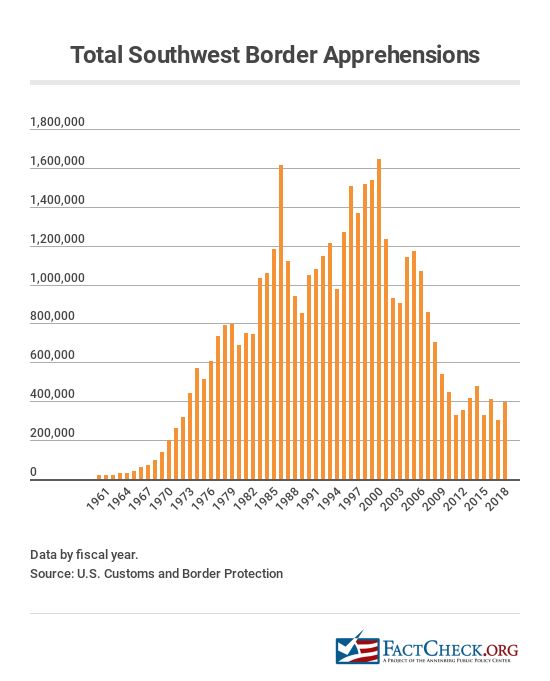
"He brought illegal immigration to 5% of what it was,"


This article from FactCheck.org (https://www.factcheck.org/2018/06/illegal-immigration-statistics/) has data through 2018, but shows a significant drop in many of the metrics PRIOR to Trump taking office, and honestly, not a lot of movement in the two years of his presidency until the article was written. 


The 2020 report from the Department of Homeland Security (https://www.dhs.gov/sites/default/files/publications/immigration-statistics/Special_Reports/Enforcement_Lifecycle/2020_enforcement_lifecycle_report.pdf) also doesn't seem to show that much decline since Trump took office, and more declines prior to his inauguration. 


The Southwest Border information here (https://www.cbp.gov/newsroom/stats/sw-border-migration-fy2020) is a little bit harder to read, but clearly the years Trump was in office were not consistently better than the years prior, and certainly not 95% better.


"lowered unemployment for all people groups and ethnicities"

This albeit Opinion article from the Tampa Bay Times (https://www.tampabay.com/opinion/2020/10/23/a-chart-of-unemployment-under-trump-and-obama-tells-quite-a-tale-column/) shows a clear chart and describes the impact this way: "During Trump’s first three years in office the unemployment rate declined from 4.7 percent to 3.5 percent — a 1.2 percentage point decline — quite satisfactory but nothing earth-shaking as his administration would like you to believe. If you look at the chart, 2017-2019 is an extension of the same downward trend (momentum) in the unemployment rate that began in 2010. Moreover, the slope flattens a bit during Trump’s tenure implying that the job creation rate was a bit slower under his tenure."


The BBC (https://www.bbc.com/news/world-45827430) shows similar charts that imply the economic success under Trump was also a continuation of trends started before he took office. As far as helping all groups and ethnicities, the article cites, "This overall national figure masks wide variations across regions and ethnic groups in America. In 2019, while 10.5% of the population was defined as living in poverty, the figure for black Americans was 18.8 and for white (non-Hispanic) Americans it was 7.3%."

This Associated Press Fact Check article (https://www.usnews.com/news/politics/articles/2020-06-07/ap-fact-check-trump-exaggerations-on-blacks-economic-gains) states bluntly how unevenly the benefits have come: "The joblessness figures in Friday's report did not improve uniformly across racial and ethnic groups. The unemployment rate did decline last month for white workers, to 12.4% from 14.2% in April, as well as for Latinos, to 17.6% from 18.9%. But joblessness actually rose slightly for African American workers, to 16.8% from 16.7%. For Asian Americans, it increased to 15% from 14.5%." The article then goes on to say:

"Black unemployment reached a record low during the Trump administration, 5.4% in August, as the longest economic expansion in history pressed ahead.
"Most of the progress came when Barack Obama was president: Black unemployment dropped from a recession high of 16.8% in March 2010 to 7.8% in January 2017. Improvement continued under Trump until the pandemic. Black unemployment reached 16.8% in May, compared with 13.3% for the overall population.
Not all economic measures improved for African Americans under Trump before the pandemic. A black household earned median income of $41,361 in 2018, the latest data available. That’s below a 2000 peak of $43,380, according to the Census Bureau.
"More broadly, there were multiple signs before the pandemic that the racial wealth gap had been worsening."


"attended prayer meetings with pastors"


I'm not even going to research this because if this is how you measure the success of the US Presidency, I just can't even debate with you. I understand this is one of many highlights in the OP's mind, but this has no value or meaning to me.

"appointed SCOTUS justices that uphold the sanctity of life."

Again back to the abortion topic, but a different action. If your prolife views are a predominant reason you support Trump, I understand if you view this is a victory. But even if this is a victory in your eyes, I can't imagine a moral person looking beyond the apparent hypocrisy as discussed here (https://apnews.com/article/election-2020-ruth-bader-ginsburg-merrick-garland-elections-us-supreme-court-bb9932748b199f793cb2ccbefa713a5f). McConnel had to back peddle a bit to justify his hypocrisy, and "It doesn’t pass the smell test in any way."

"He move the US embassy to Jerusalem and supported Israel to see the best peace they have had in many decades."

Indeed, he did make the bold move of the embassy. I could not find statistics that support or refute the claim that Israel has more peace now. The embassy move came with protests and threats from Palestinians, and indeed, Israel was not wholly left alone as demonstrated by the headline and details in this article "Trump Campaign Declares Middle East Peace Achieved As Israel Sustains Rocket Attacks" (https://www.forbes.com/sites/andrewsolender/2020/09/15/trump-campaign-declares-middle-east-peace-achieved-as-israel-sustains-rocket-attacks/?sh=4ce1a77d5e36) in which 13 Israelis were injured by Palestinian rockets shooting for 3 hours. But whether the level of violence is lower or the same (or higher), I could not determine in the time I spent researching. One of the major criticisms of the Trump campaign's claim of achieving peace is the fact that the agreement made was between countries that were not actively at war with Israel. The campaign even went so far as to promote the idea that Trump should be awarded the "Noble [sic] Peace Prize."


"He actually reduced coal usage"

This is an interesting claim to promote, given that Trump was actually promising to save coal production jobs. But, I certainly can appreciate that Trump supporters, like most humans, have their own values which can differ from others, even those they support. I, myself, was a Republican that wanted sustainable energy at one point. So, I'm here for it.

My research shows that this is true, coal usage decreased in Trump's presidency, something we can't say for the previous Republican President. However, a simple graph once again appears to show that the reduction was a continuation of a downward trend that started after plateauing near its peak between 2005 and 2008. 2009 saw a huge drop (perhaps because of the economic downturn, I'm not sure though), and then mostly has come down since 2010. This Forbes article (https://www.forbes.com/sites/chuckjones/2020/08/26/trumps-coal-resurgence-promise-has-gone-underground/?sh=b79f81b56d8e)  talks a lot about the results of Trump's Clean Air Act. For straight data, take a look at this chart (https://www.statista.com/statistics/184333/coal-energy-consumption-in-the-us/). 


"and even though people want to blame him for Covid deaths, never has more assistance been given by an Administration to see therapeutics and vaccines developed and delivered in response to a respiratory disease."

Trump initiated Operation Warp Speed, promising millions would be vaccinated by the end of 2020, which didn't happen, but we are getting close. There are now two vaccines approved by the FDA - Moderna and Pfizer. Moderna did partner with the administration as part of Operation Warp Speed. However, Trump's campaign claimed victory for Pfizer's vaccine development. "In fact, Pfizer partnered with the vaccine’s original developer, Germany’s BioNTech, in March and the following month announced the first human study in Germany. The White House announced Operation Warp Speed in May… The company says it has risked $2 billion of its own money on vaccine development and won’t get anything from Washington unless the effort is successful… However, Pfizer did sign an agreement with the U.S. government in July worth $1.95 billion — if the vaccine pans out and is cleared by the FDA — to supply 100 million doses." (source: https://www.baltimoresun.com/coronavirus/ct-nw-coronavirus-vaccine-fact-check-20201113-pkzbkcfd5bcalpgkvbavqfi5iq-story.html)

Moreover, downplaying Trump's responsibility for the pandemic deaths is a pretty big error in my opinion. Despite his Operation Warp Speed to get a vaccine, there are Trump followers who still believe the COVID-19 is fake, largely due to Trump's misleading rhetoric around the virus. Now the administration is claiming victory on the pandemic, even as cases continue to rise. I found this Opinion piece summarizing the reason people blame Trump for the COVID deaths: "12 ways the Trump administration botched America's response to Covid-19" (https://www.cnn.com/2020/10/29/opinions/ways-trump-botched-covid-response-holtgrave/index.html)


"He also restored due process to the prosecution of accusations."

Admittedly, I had to look this one up because I had thus far missed it. In theory, it does sound like the right thing to do - to provide the accused the assumption of innocence and put more structure around making determinations that would lead to consequences for the accused. This article proclaims victory at last (https://www.nydailynews.com/opinion/ny-oped-due-process-at-last-20200506-arjngpvxkneqtajeypn6gc3dtq-story.html).
 
However, there were some arguably immoral aspects of the new Title IX rules, including "changing the definition of sexual assault to require that it be 'so severe, pervasive, and objectively offensive that it effectively denies a person equal access to education.' This change means that students would be forced to put up with escalating levels of sexual harassment without getting help from their schools; many incidents of sexual harassment and violence would no longer 'count' (From https://www.newsweek.com/trump-administrations-new-title-ix-rules-are-attack-students-metoo-opinion-1503216). Additionally, evidence is quite a challenging and subjective topic, one that sounds great in theory but much more challenging in practice.

Like abortion, this is another tricky topic, I believe, because sexual harassment and sexual assault is so pervasive and yet so hard to prove. Of course, nobody on either side wants to see an innocent man to be accused and to suffer whatever consequences come with a guilty verdict. But, we also have a moral obligation to fight against sexual harassment and sexual assault. The risk here, of course, is that these new regulations will allow offenders to more easily get away with real acts of violence and sexual assault, and potentially go on to repeat the offenses, knowing how to "get away with it." This is both a victory and a loss when you look at it with an open mind, I believe.

"For all the bad people see,"

I'm breaking this comment out separately because I think it needs to be said: Words matter. Actions matter. But words still matter - especially when those words invoke actions. The 911 and poison control calls resulting from Trump's suggestion to drink disinfectant (https://www.forbes.com/sites/robertglatter/2020/04/25/calls-to-poison-centers-spike--after-the-presidents-comments-about-using-disinfectants-to-treat-coronavirus/?sh=67a310161157) is one of many clear examples of this.

Even before he was elected, he proved to be of poor moral character, from his "grab 'em by the pussy" comment and association with porn stars to his refusal to provide tax documents and willingness to lie about the reasons. I mean, for all that birther crap he pushed during Obama's terms, doesn't it seem hypocritical to not share documentation of his own when called for?

The bottom line is this: He lies. Now, politicians are often stereotyped as a bit of a deceitful bunch, and many fail to deliver on some or all of their campaign promises - Trump would not be the first in either of those two categories, not by a long shot. But he lies so fluently, so easily, and so often, not just exaggerating but outright lying, that for people paying attention and not under his spell, it's become impossible to believe a single word he says. With all my might, I cannot put aside his demonstrated (and boasted) lack of moral integrity to see how a God-fearing Christian or Jew can support him wholeheartedly or defend his morals. If the only thing you care about is abortion, fine, he's walked and talked in support of prolife while in his campaign and office (although he had previously said he supports choice). But if you care about literally any other moral aspect, you have to see that he's much more than imperfect.

Those of us who have dealt with extreme narcissists recognize him well - he is the kind who will stop at nothing to gloat and win for his own good, and he will only pretend to care about others when it suits his cause to do so. When we're talking about the Presidency, we're talking about a leader for our great country, and being a leader should have morality as a responsibility and criteria.

Another Trump-supporting friend commented this similar sentiment: "You just screwed us because you couldn't hit the mute button when Trump talked or tweeted."

Hitting the mute button should not be a recommendation. Defending someone by saying you should hit the mute button when they talk is not ok, but if that someone is the President of the United States, it's really, really wrong in my opinion. Sure, actions speak louder than words, but words still matter. Words. Matter.

"and as so many are firm of upholding that this election has no shenanigans,"

I wouldn’t agree that there were "no shenanigans," but yes, most of the country, the millions who voted for Biden especially, do uphold that this election was free and fair. The reason is because the evidence to the contrary has been disputed and the courts have ruled that there was no sufficient case for fraud. Anecdotes that a dead person voted or someone used a loophole that one time for that one case does not mean there was widespread election fraud. The numbers changed overnight? Well yes, that was clearly and obviously related to the mail-in ballots, heavily favoring Biden since Trump discouraged his voters to use mail-in voting. Remember, these were largely the same election officials and same election rules as in the 2016 vote, when much of the country was shocked and appalled that Trump came out a victor. If there was a deep-state invisible hand guiding the election process, don't you think they would have named Hillary the victor four years ago? This is not a media thing, nor a conspiracy. The only conspiring here is widespread action of the millions of honest US citizens who voted for Biden (or against Trump) because they have been so appalled by Trump's Presidency that they were moved to vote. There are a million articles on this topic, google it if you really want a source for this one, I'm exhausted by it all.

The more infuriating thing, I think, is again the hypocrisy. In 2016, Democrats contested certain election results as the rational world was still stunned by the apparent Trump victory, and Trump ranted about how Democrats were such sore losers and should just accept the results. Those comments couldn't be more applicable to Trump's actions in 2020 and the start of 2021.


"he single-handedly brought more people to the voting booth than ever in history."

Well, yes, indeed he did. Was it because he inspired civic duty, though? Because that's obviously what this comment is meant to imply. I feel like there's something to be said about the means to an end justifying the means, here though… 

 I think what Trump supporters don't seem to grasp is that the hatred of this despicable man is what drove so many people to the polls favoring Biden. The book, "The Keys to the White House" proposes a prediction methodology that has worked for every election up until 2016 on the basis of one overarching idea: that the US vote is, more than anything else, a scorecard on the current President's performance. In the theory, there are 13 keys, and most of them have to do with the current economy, foreign actions, and current President and current Congress. Only one of the 13 keys relates to the challenger in the race, and one other key relates to other challengers in the sitting President's party. This theory predicted Trump to win the popular vote in 2016, which he didn't actually, but he did win the electoral college, which we all know is what matters. This was the first time the theory was disproved, but even still, it was partially right in that Trump won the Presidency. So the fact that many more people came out in droves to determine if Trump would get a second term, I think, is very obviously a direct correlation to the passion both sides have. And indeed, there were enough people voting against Trump, more than ever in history, to beat the large numbers of people who voted for Trump, which was also a record. 

Comparing it to all of history, however, is overexaggerating the reality, considering the population has, of course, grown over history as well. As a percentage of the eligible or voting age populations, this election was NOT, in fact, record breaking. (Source: https://en.wikipedia.org/wiki/Voter_turnout_in_United_States_presidential_elections)

Saturday, January 2, 2021

Makai, Toji, Abbiocco: My Favorite Places to Travel To

One of the hardest things about 2020 was the inability and reluctance to travel - obviously, some travel was technically possible but it would be far more difficult than normal and risky, of course. Before the COVID crisis really escalated, we were fortunate enough to take a 16-day cruise through the Panama Canal, which also brought us to a beautiful island in the Bahamas, Columbia, and multiple destinations in Mexico. And while that was a lengthy and extravagant vacation, it seems so long ago, even though it has been less than a year. We moved to San Diego shortly after, and would have loved to hit up Sea World and Disneyland, but both have been closed since we got here. The San Diego Zoo opened for a bit, and we got memberships and have visited often, but it is now closed again. The biggest disappointment was that the Tokyo Olympics were postponed, which we had tickets to and had been looking forward to for years! Hopefully, we'll be able to go this year if the games are not cancelled altogether.

While I think about 2021, I knew January 1st wouldn't mean COVID disappears and politics are perfect and racism no longer exists or anything like that. But I do see in 2021 a hope for healing - healing for our country, the start of the end of the pandemic, the ability to gather again and hug one another, healing to be had at funeral services postponed from last year, and maybe even better understanding and practices around race issues. Indeed, one can hope, right? And the thing that I look forward to most is to be able to travel without extraneous precaution or guilt. And though that is still in the future right now, I've been thinking about the reasons I like to travel and the places I've loved and want to visit again.

I've yet to visit South America in earnest (having just merely touched down in Columbia on our cruise) or Africa. In addition, there are many more places in Europe and Asia I'd like to visit, not to mention other places here in America. But I have visited three countries in Europe, two countries in Asia, multiple cities in Australia, and many states and landmarks in America. From these travels, there are three places I've felt absolutely, indulgently, at a peaceful perfection. I call these my "Happy Places" but they are so much more than that. They are places that calm, heal and inspire me. In the spirit of, "Eat, Pray, Love" I present a slightly lengthier version: "Makai, Toji, Abbiocco." These are words in the native languages of my three places.


Makai: Oahu

I may very well be taking this Hawaiian word way out of context, but I love the sentiment. It is common in Hawaii to give directions that mean towards the mountains (mauka) and towards the ocean (makai). My happiest place on Earth is at a specific restaurant on Waikiki called House Without a Key (which I often forget the name of, and call it Room without a Door instead). I discovered it the second time I went to Hawaii - the first time I went with my sister, nephew and Mom, and we stayed in Waikiki but on the other side of the beach. The second time I went was with Jaiman and his family for his grandmother's 80th birthday, and that was when I discovered this beautiful restraurant. There are a number of elements that make it perfect for me. For one, they have live traditional Hawaiian music performed nightly with hula dancers, which just puts me in a sort of zen trance. Another selling point is the fabulous cocktails - the Mai Tai is to Mai Die for! There is usually plenty of seating, and just enough lighting to see the people you're with but not so much that it drowns out the serene landscape as the sun sets. By far, the best part of it, though, is the location - it is settled right on the beach, with captivating views of Diamond Head and the whole Waikiki landscape, and of course, the beautiful big blue ocean. But, it is just slightly elevated so as not to be sandy - those of you who know me well know that I have a very strong aversion of sand and sandy feet. My love of the ocean is almost perfectly matched by my absolute hate of dirt and sand. Having lived in Panama City Beach, Florida for over a year, I got better about sand, especially because the sand there was much thinner and cleaner, so it put me more at ease. Now that we live in San Diego, I hope to go to the beach frequently, although it certainly won't be as often as when we lived in Florida because it's quite a hassle. Due to COVID precautions and shut-downs, we've only gone once, for my birthday, so far, but hopefully that will change in 2021. 

Anyways, I would love to return to Hawaii and explore more of the islands - I hear Maui is very nice and would like to visit that island. However, I think I'll still want to return to Waikiki and visit House Without a Key. I think it's so captivating because it indulges all my senses - the smell of the ocean breeze, the taste of the Mai Tai, the sound of the Hawaiian music, the breathtaking sights of the water, beach, mountains and dancers, and the feel of stable concrete under my feet (instead of sand). One of the things I loved about my last visit to Oahu was driving around the island, listening to Hawaiian radio and taking in the various sights, and then winding up at House Without a Key at the end of the day, as if that was my home base. A Hawaiian phrase I love is "Nānā i ke kumu" which means "Look to your Sense of Place and sources of spirit, and you find your truth." That is what House Without a Key is for me. Click here to watch the video recap of our trip to Oahu when I found this little piece of heaven on earth.

Toji: Miyajima

My Host Family, the Mitsuis

I studied abroad in Hiroshima during college, and my Host Mom gave me one of the most memorable and liberating experiences of my life, bringing me (unbeknownst to me) to an Onsen, or Japanese hot spring bathing house. The waters of the Onsen are considered healing and promote beauty and wellness. As long as I can remember, I've always loved taking baths, perhaps even more than I love swimming in the ocean, so the Onsen is a little like the ultimate bath. However, there are some things about the Onsen that are a bit foreign to Americans, especially a young, naïve, white, well-endowed American woman. For one, no bathing suits or coverings are permitted in the Onsen. In fact, the tiny towels (hardly larger than a hand towel) must be kept 15 feet or so away from the bath. 

The Onsen

So, if you're not comfortable with nudity and with being completely exposed, you may be a bit challenged in the Onsen. To be sure, male and female areas are separate, so you're only naked among your own gender. However, Japanese women's bodies are quite different than, well, than mine. And it is not considered rude to stare like it would be in America. So my boobs, free of a bra and all other coverings, attracted unabashed eyes everywhere I went. 

For added drama, my American classmate who was with me had a giant tiger tattoo over her stomach, which attracted not only stares but dirty looks, as tattoos are quite taboo in Japan. What's more, there is an element of racism, or at least a belief that Americans are "dirty," thus many Japanese women would exit the baths when they saw us coming, whether it was because we were white or because of the tattoo, we would never know. Anyways, it was a little like baptism by fire, I quickly had to become comfortable with my nudity in order to enjoy myself. 

Sakino outside the Onsen

Ultimately, I really did enjoy the hot, fresh water, the serenity of the surroundings, and the social aspect with my classmate our Host Moms. We even sort of met up with the guys in our group on the rooftop, separated by a fence but able to talk to each other when we ended up there at the same time. Ever since that first experience, I have been quite comfortable with my nudity, whether it's at a doctor, with a massage therapist, in a tanning bed, or, of course, in an Onsen. We were able to somewhat replicate the Onsen experience in Truth or Consequences, New Mexico, when we stayed at a hot springs hotel there. Most of the hot spring baths were public, mixed-gender and required swim suits or coverings. But, you could rent a private hot spring bath overlooking the river, and obviously wear whatever you want in there. However, the whole experience just wasn't quite as tranquil as the Onsen in Japan. 

Another place we visited while I studied there was the island of Miyajima, a ferry ride away from Hiroshima, where the deer will walk right up to you and try to steal your food or rifle through your bag. Supposedly, there are equally friendly monkeys in the mountains there, but in two journeys up and down the mountain, I have yet to come across them, and I've heard the same from other travelers. 

When Jaiman and I went to Japan for his first time, I insisted we make the trip to Miyajima and stay on the island for a few days. When we arrived, we were exhausted from travel and I had totally forgotten all about the amazing room I had booked. We stayed at the Miyajima Grand Hotel Arimoto, and the room I had booked was a traditional Japanese-style apartment with a private Onsen bathtub on the patio. "Toji" is the word for Onsen therapy, and that was exactly what I did for as much time as I could while in Miyajima. My body's clock was off the whole trip, so I'd wake up around 3 am full of energy and unable to sleep one more second, so I'd get up from the futon and soak in the Onsen for hours until Jaiman got up. We also enjoyed the meals there, as well as the Buddhist temples and Shinto Shrine, and of course, the deer and the natural beauty of the little island. Thus, Miyajima is my second happy place on Earth. Read more about Miyajima here.

There are also a ton of other amazing things to do in Japan. If you're interested, read my Japan Guide here.

Abbiocco: Venice

Because I've been so interested in Asia and focused so much of my travel thus far to Japan and China, I've only been to Europe once so far, visiting Italy, France and Spain. I am sure there is so much more to enjoy in Europe, but from my limited experience thus far, Venice was absolutely and by far my favorite city. The fact that it sits on water and a series of canals probably has a lot to do with it - I love all things water, from baths and hot springs to boats and the ocean, and canals and rivers are certainly part of that. But when I think about Venice, it's not just the beautiful landscape and bajillion winding corridors and bridges that I long for. I don't have much of a sweet tooth, so it wasn't the gelato, although that was delicious. And it wasn't necessarily the food itself, although it was all amazing, and perfectly paired with the abundant amounts of wine we had. What I love about it is the feeling of eating in this vibrant yet serene place. So the word I chose, abbiocco, is Italian for "the drowsiness that follows eating a big meal."


Honorable Mentions

Uluru - Perhaps the only place I absolutely loved that wasn't associated with water; in fact, it may be the perfect antithesis to water. There are a number of activities to do in and around the resort complex and the giant Ayer's Rock, Uluru, but I most enjoyed the view of the rock from our room. Read more here.


Niagara Falls - There are so many activities to do at Niagara Falls, not to mention the amazing ice wineries just a half hour north in Niagara-on-the-Lake, but my favorite memory of Niagara was having the amazing view of the falls from the comfort of our bed in our hotel room at the Sheraton on the Falls. 


Cosmopolitan Hotel in Las Vegas - The Fountain View rooms with balconies at the Cosmo afford amazing views, and many have nice bath tubs. We also love Secret Pizza and the many other delicious offerings at the Cosmo. During COVID lockdown, with so much closed, we went to the Cosmo twice, once for a small wedding, and once just to chill in luxury - we literally don't have to leave the hotel because it has just about everything we need to enjoy ourselves (and just a short walk away from our favorite Vegas drinks). 


Taku Glacier Lodge in Alaska - This was an excursion I did all on my own when my family did an Alaskan cruise. There are a lot of really wonderful and exciting things to do and see in Alaska, but this is one of the more unique experiences that I would do again in a heart beat. The excursion from Juneau included a round-trip ride on a seaplane to this remote little area overlooking a glacier and serving up a fishbake in a cozy little wilderness lodge. I don't usually enjoy eating fish, but I had to try it. I also enjoyed walking around the grounds, where a guide identified bear droppings - the possibility of running into a bear on the trail was a little exhilarating. Click here to watch my video recap.


A cabin in Show Low for Christmas - Throughout my travels, I have often found that I've gotten lucky with things that one cannot plan or pay for, like weather and wildlife. My family rented a cabin on AirBNB for Christmas one year up in Show Low, Arizona. The weather forecast did not show snow, but we were hoping. The weather leading up to Christmas Eve was cool but refreshing, and we took lots of walks and enjoyed time by the fire. Then about 4 pm on Christmas Eve, it started snowing, and it wasn't much by the time it got too dark to see. But on Christmas morning, about 4 inches had accumulated, and kids and adults alike spent hours playing in it, something we didn't get to do much living in Tucson and Phoenix at the time. The company and the lucky weather, paired with the beautiful cabin we rented, made it just about as perfect as a Christmas could possibly be.


So there you are, my happy places, my Makai, Toji, Abbiocco. 

May this year allow us to once again travel, and may we never take travel for granted!

Monday, September 21, 2020

DIY How To: It's Sew Easy Pillows

Throw pillows are one of the easiest and most obvious ways to incorporate a fun pattern, color and texture into a room, especially a living room or bedroom. Staying consistent with my decorating theory, I recommend making large throw pillows with big, bold graphics and colors. Go for size over quantity, they'll be easier to manage, less likely to fall all over the place, and have a bigger visual impact. In fact, I tend to oversize my throw pillows for this reason.

If you're buying custom fabric, like from Spoonflower, for example, there are lots of choices of the actual texture / fabric type. If you want something durable that could go outside, I'd go for a canvas fabric. If you want something super soft, go with a Jersey or Minky. I love the pillows I've made with it, and even intricate designs print really well on the fabric. For this project, I'll use a custom printed design on Minky!

Step 1: Buy the material
For two rectangular pillows, you'll want at least 1 yard of material. If you want to go bigger, you'll need to get a few to several yards. Square or rectangular pillows are "sew easy" because you barely have to design or cut anything.


Step 2: Halve the material (a number of times)
Cut the fabric in half to get the two pillows, and cut it in half again if you're going for more than two. Then, cut the fabrics in half one more time so you have the two sides of the pillows.


Step 3: Place and pin
Take the two sides of the pillows and place them with the patterns facing in to each other, and align the edges. While it doesn't have to be perfect, you do want to make the edges and corners align as best as possible, because this will maximize your pillow size and minimize rework in your sewing process. Now take your pins and place them through both sheets, perpendicular to the direction of the edge.


Step 4: Sew 3 3/4 edges
I would definitely recommend using a sewing machine, as it will make this process much quicker, although it is possible to sew by hand. Place the corner of the fabrics under the needle and lower the foot to hold the fabric in place. Make sure you have enough fabric hanging over the other side of the needle so that the edges don't get loose. I was taught to sew forwards and backwards a couple times at the start and stop, to make sure the thread is secure. Sew along the edge, making sure you have both fabrics still as you go along. When you get to the next corner, lower the needle through the fabric, then raise the foot on the sewing machine. Rotate the fabric around the needle so you can continue sewing along the next edge. Lower the foot again, and continue along the edge. Leave a few inches open on the last edge (and again, I would sew in reverse and forward a couple times to secure the thread). Remove the fabric from the machine and cut the excess threads.


Step 5: Flip it
You've basically now sewn the pillow inside-out, so that the ugly part of the seams will be on the inside of the pillow. Pull the fabric through the opening to flip it inside out. If you've left only a very small hole, this may take some time to pull through. You can use a pen or the eraser end of a pencil to help push fabric through the hole.


Make sure you push the corners out as far as they'll go.


Step 6: Fill it
Stuff the pillow with polyester filling you can find at craft stores, making sure to work it through to the far corners first, and then filling it up as much as you'd like. Fuller pillows are generally preferable to flimsy pillows, so make sure you have more than enough filling. (That's Carly-Dog in the picture giving me moral support!)


Step 7: Complete the edge
When you're satisfied with your filling, sew the last part of the open end shut by hand. Then, throw it at your favorite person or pup to celebrate your throw pillow! Last part is not required, but highly recommended!


Step 8 (Optional): Add some flair
You can add buttons to the center of the pillows for a classic look, or add some frills or faux fur or some other kind of accent to two or four of the outside edges.

If you want to add some interest to your pillows, you can use a pattern on one side and a plain color or another matching pattern on the other side. The only trick with this is that you'll just have to ensure the fabric pieces are the same size, as some fabrics come in different widths than others.


Not Sew Easy Pillows
For a little bit more of a challenge but also more unique end products, try sewing a cylindrical pillow. You'll need two evenly-sized circles of fabric and then a rectangle of fabric that matches the circumference of the circles. Sew the circles onto the rectangle first, and then the horizontal seam.

Depending on what theme you're going for, you may have a desire to try a shape other than square or rectangular.  For example, a Moana-themed room may have a triangular throw pillow representing the iconic sail. Or you may want to use a plain fabric to make an abstract shape of a rocket, a magic lamp, a rose, a top hat, etc., and then use an iron-on to print onto the center of the front of the pillow.

Maybe you want to add a pocket to a pillow, in which case you'd want to do that on the fabric before constructing the pillow. This might be cute for a pillow representing Woody's shirt, for example.