Sunday, March 31, 2019

Japan Guide: Where to Stay

Where to Stay - Tokyo

Capsule Hotels are great - read more about my experiences here:

Capsule Hotel - Brilliant or Terrifying?

Capsule Hotel: Bather Tested, Claustrophobic Approved!

Of major importance is to note that most capsule hotels are only for men, so if you are a woman or will be traveling with women, make sure to find accommodations that allow women. A lot of people have a visceral reaction to the idea of capsule hotels, but I would challenge you to at least try it for a night as part of your Japanese experience - you will likely be pleasantly surprised!

Whether or not you stay in a capsule hotel or a traditional hotel, location is also key in Japan. I would also recommend staying fairly close to the train stations, especially those for the JR line. You'll know they are JR line stations if you look for public transit directions on google and they have a line that starts with "J", like "JK" for example. This will allow you to easily access the rest of Tokyo
easily, and you won't have to drag your bags too far to get to your hotel.

The Akihabara District is popular with gamers and fans of nerdy things like Anime, Pokemon, etc. We really liked our hotel here, the Remm Akihabara hotel. It was right next to the station, near food and a convenience store, and easy to find.

The Shibuya District is the high fashion district, with artists on the streets just about every night, trying to be discovered, and infamous for its "Shibuya Scramble" - one of the busier pedestrian crossings you'll see.

Shinjuku is another vibrant area with lots of shopping and food.

I would just recommend that wherever you are looking, look for pictures to make sure you're comfortable with what you're getting. Rooms are very small typically. I prefer to use Travelocity to book hotels, it has treated me well. I don't care for hotel breakfasts here (usually fish or unappetizing sausages and seaweed wraps or whatever). We like picking up breakfast (and sometimes dessert or nightcaps) at local Family Marts or 7 Elevens, they're virtually everywhere and a lot of the food is labeled in English. Look for unique Kit Kat flavors there, too! There are also McDonald's and Burger Kings around, so breakfast is pretty easy.

Where to Stay - elsewhere

I want to put in a plug for one of the most amazing experiences we had in Japan that most people aren't really aware of. We stayed on the island of Miyajima,
just off the shore of Hiroshima. You'll take a ferry from Hiroshima to get there, and will immediately be greeted by the deer who often walk into the ferry station to look for snacks in newcomers' bags. We had booked a pretty neat room at Miyajima Grand Arimoto, and our room included a private onsen (hot spring bath). The food was incredible in Miyajima, and while it had some touristy parts of it, it felt like it catered to Japanese tourists rather than tourists from outside the country. Miyajima is one of my happiest places on this Earth, and I hope more people will get to experience its magic and beauty. Read more about my Miyajima experience here. 

More Japan Guide

Getting There / What To Bring 
Training It - The Best Way to Get Around in Japan (Trains) 
Where to Stay
Eating Out
Things To Do 

Key Phrases

Japan Guide: Tips for First-timers and Returning Visitors to Japan

I've recently returned from my third trip to Japan, and it has spurred a lot of conversation with colleagues, friends, and total strangers like Uber drivers and the girl at the DMV. For those who haven't been, Japan can seem like an "exotic" place to visit, but for Jaiman and I, it's as natural as any adventure. There are some really neat aspects of Japan that make it very friendly to tourists as well some aspects that are a little daunting to newcomers. After a number of these conversations, I thought I'd put together a semi-comprehensive guide to visiting Japan.

Embedded in this guide are tips for what to do and what to expect in certain situations. I believe knowing what to expect helps people feel more comfortable when confronted with something so completely different like a whole new culture. Here is a summary with links to each of the sections:

Getting There / What To Bring (below)
Training It - The Best Way to Get Around in Japan (Trains) - What to expect at the train station and how to prepare and navigate for using trains as your primary mode of transportation in Japan.
Where to Stay - What to look for in hotels.
Eating Out - No tipping, and taxes are usually included! And other tips for what to expect at Japanese restaurants.
Things To Do - My recommended Must-Dos as well as some other fun ideas for your itinerary.
Key Phrases - Don't Miss This Section! Most people in Japan are not great at English, so it is very helpful and respectful if you have some basic Japanese phrases under your belt when you go.

Bonus: Japan Is Weird (Different) and Confusing (Unfamiliar) and I Want to Go Back - Some quirks and our favorites from our previous trip are discussed here


Getting There

Narita is the bigger airport in Tokyo, but both Haneda and Narita are fine to fly into and out of. Most itineraries will go through Tokyo, even if you're going elsewhere in Japan. As such, I'd recommend flying to Tokyo and staying there for a few nights if your schedule permits, and then you can always take a bullet train to other parts of the main island instead of getting back on an airplane. If you plan to ride the shinkansen, or bullet train, I would recommend you look into the JR Pass for Visitors before you go, you can get a really good deal and save hundreds of dollars, but you have to buy it before you get to Japan.

Flights from the US are lengthy, at least 10 hours and up to 15 hours depending on where you're flying from. When you land, you'll be about 12 hours off from your previous timezone, so it's important to sleep a little but not the whole time on the plane. The best way to ward off jetlag is to stay up most of the arrival day, and then make sure you go to bed at a decent time the first night.

Many major airlines have personal screens with entertainment, and free alcohol for international flights. You'll also notice that announcements will be made in Japanese and English, and potentially Chinese or Korean as well. While checked luggage may be free for the international flights, I prefer to pack lightly (at least on the way there) so that I can limit myself to carry-ons. If you plan to do a
good amount of shopping, it may be a good idea to bring an empty collapsible bag to fill up with your goodies to bring home. Don't worry, though, if you forget, because you can find cheap bags for this purpose in Japan, too (Jaiman got a huge duffle bag for about $16 USD). 

What to Bring

Definitely bring plenty of Japanese cash (yen) to avoid costly ATM fees, you'll need cash at the train stations and at many restaurants, street vendors, vending machines, etc. Major credit cards (Visa, Master Card, Discover) are accepted at many places, but not all. Make sure you know which credit cards have foreign transaction fees. My Discover card doesn't have foreign transaction fees, for example, so I prefer using that when possible, but sometimes places don't take Discover, so then I'd have to use cash or another card and pay the small fee.

Umbrellas are a good idea generally, but they can be purchased pretty readily if you need one while you're out and about.

Bathing suits are a good idea if you plan to go to a public hot spring / onsen. Many are separate by gender and are only used in the nude, but some will have coed spaces for those with bathing suits.

Comfortable shoes are a must, it doesn't matter how little you expect to walk, you'll probably walk more than you expect. 


More Japan Guide

Getting There / What To Bring 
Training It - The Best Way to Get Around in Japan (Trains) 
Where to Stay
Eating Out
Things To Do 

Key Phrases

Thursday, March 28, 2019

Capsule Hotel: Bather Tested, Claustrophobic Approved!

Two years ago, my boyfriend, Jaiman, and I visited Japan together and accomplished a number of Life List goals, including sleeping in a capsule hotel for me. Jaiman is a bit claustrophobic so he opted out of the capsule hotel then. But after I told him about how wonderful my experience was (and you can read my glowing review here), he became more open to it. We recently returned to Japan for another visit, and this time, we made reservations for both of us at a capsule hotel. I chose a different one this time to put us in Akihabara, and in doing so, had very much a different experience (some positive and some negative). I thought I'd share a little bit here, to update my general recommendations around capsule hotels for visitors so you know what you may want to look for, and what could be useful for future developments as well.

First of all, most capsule hotels are for men only, so the selection for women are limited. As such, I can only visit and review a small portion of capsule hotels. The one I selected this time is called Glansit Akihabara Comfort Capsule Hotel. I was a bit bummed to learn that there was no restaurant on property, so after
checking in and putting our things away, we had to retrieve our shoes and head back out for dinner. It is worth noting, however, that there was a really good ramen place just next door that we really enjoyed. Both capsule hotels had a good Wifi signal and plenty of places to charge your phone and other devices.

As with my previous capsule hotel, shoes are removed right in the lobby and you wear slippers provided to you for the rest of your stay. The capsule hotel is
really set up to provide just about everything you need to stay over, even if you didn't intend to stay away from home that night. Meaning, they provide toiletries, pajamas and towels, and they had a vending machine in the lobby to buy fresh underwear (for men), socks, undershirts, etc.

Further comparing this capsule hotel to my previous one, there were quite a few drawbacks from my perspective. The biggest I think was that the capsules
weren't very soundproof, so it was quite noisy as the woman in the capsule above mine moved around. I don't recall this being an issue at my previous hotel. The lounges were separated by gender (i.e., a male lounge and a female lounge on separate floors), which meant I couldn't hang out with Jaiman like I would have been able to at the previous hotel. This may be a plus for single travelers or same-gender groups, because you can perhaps be a bit more comfortable with your own gender. The showers/bath were on the same floors as the lounges, which meant in order to go bathe, I had to get into the elevator to change floors, which I found quite awkward. The good news is that the men's floors were all the bottom floors, so in theory, the men shouldn't be in the elevator going up to the women's floors, but it did happen once while I was there. Also, the shower stalls were open, which I don't think was the case at my previous capsule hotel. The toilets were on the same floor as the capsules, but the stalls were very small and there wasn't a hand washing station with soap on the floor, just a sink with water. The changing room / locker room was also very small, such that if I was changing, there wasn't enough clearance for another woman to go around me. In general, everything was just very, very tight, which obviously does not need to be the case based on my previous capsule hotel experience.
The pillows here were, I believe, more "traditional Japanese", meaning not the conventional pillows an American might expect - I'm not sure how to explain them but they are more firm and filled with something like rice, versus soft and fluffy. I would lean on calling this a negative, but the pillows weren't actually uncomfortable, so I'm a bit on the fence on them.
On the plus side of this capsule hotel, the pajamas provided to me by the hotel actually fit, which is especially impressive since I'm larger than the average Japanese woman and often have difficulties finding things that fit. Also, a big plus was that the pull down shade on the capsule was much darker / more effective than my previous hotel, making the capsule darker when my lights were out. The TV in this capsule was much larger, and came with headphones to listen to it. A bonus from my perspective was the large soaking tub that was constantly replenished with perfectly comfortably hot water. I don't believe it was a hot spring or onsen, I believe it was tap water, giving the bath the name of sento. Either way, I am a big fan of baths, and taking a nice hot bath after my shower really hit the spot. Now, for what it's worth, Jaiman had a very positive experience at this capsule hotel. He is 6'2" and I thought he might be challenged with the length of the capsule, but he said he was fine, although if he really tried, he could hit the curtain with his toes. Even with his claustrophobia, he had no issues or concerns sleeping in the capsule. One additional bonus was that the back of this capsule was super cushy and comfortable to lean up against, without even needing a pillow or anything to lean on.

All in all, I still think capsule hotels are a really inexpensive and practical way to stay in Tokyo, especially if you're traveling with a group or by yourself. It's also lots of fun to post pictures of your capsule for the sole purpose of shocking your facebook friends and family. If I've sufficiently encouraged you to visit a capsule hotel on your next trip to Japan, feel free to use the below table that summarizes my experiences at the two capsule hotels to decide which one you want to visit, or use these notes to look for a different hotel.


Glansit Akihabara Shinjuku Kuyakushomae
Lounge Separate by gender, free coffee / tea drinks Combined genders, has restaurant and beer
Bath Small toilet stalls, open shower stalls on separate floor, sento soaking tub Spacious and provided privacy, on same floor as capsules
Capsules Shade was more effective in creating darkness, not very soundproof, big TVs with headphones Shade let a lot of light into the capsule, more soundproof
Amenities PJs fit well, only one laundry machine Multiple laundry machines, beer vending machine, PJs were too small
Bedding Firm pillows Comfy bedding / pillows
Price $48 per night $33 per night
Book https://www.travelocity.com/Tokyo-Hotels-GLANSIT-AKIHABARA-COMFORT-CAPSULE-HOTEL.h20218454.Hotel-Information?langid=1033 https://www.travelocity.com/Tokyo-Hotels-Shinjuku-Kuyakusho-Mae-Capsule-Hotel.h3020494.Hotel-Information?langid=1033 


Here are some additional pictures of Glansit Akihabara:


Saturday, March 16, 2019

The Arguments Against UBI

You've seen the headlines. This crazy Asian entrepreneur wants to run for President so he can give everyone in the US $1000 per month. It's crazy, right? Nothing is free. It can't work. It's just a headline. 

But actually, the concept of UBI is older than our great nation. And it's not just a crazy theory, it actually has some teeth and solid evidence behind it. Below are some of the biggest arguments I've heard against UBI, and what the evidence and experts actually say about those arguments. My intention here is not to necessarily convince you that UBI is the right solution, because there's actually a lot more content out there to do that. My intention is to show that it's not just some crazy idea that will never work in reality, to prompt further questions and challenges, and to ultimately learn together if this is a feasible idea to implement in the US. 

Landlords will just increase rent by $1000 per month / UBI will cause inflation and the number will just have to keep increasing
Actually, we're in a deflationary period in terms of consumer goods. Technology has delivered the goods on improving our lives and making things more affordable. Remember, there was a time when only the richest households could afford a refrigerator or a car. Those things are much more commonplace now, taken for granted by most households. Clothes are cheaper, you can buy fruits and vegetables from all over the world instead of just what is in season in your local area, and the list goes on. The reason these things have become more affordable is competition. Housing is also subject to competition; if one apartment complex, or let's say even most apartment complexes in a given area, decide to increase the rent because their renters now have $1000 more in their pockets, the prices will go up initially. But all it takes is one complex to not price gouge, or even undercut the price gouging by just enough, and that introduces competition. Then the other complexes would eventually need to lower prices until they are once again at a place where they are competitive. With an additional $12000 per year, renters can choose to live further away if that makes sense to them, perhaps spending a little more on their commute but saving substantially more on their rent. Or, they could choose to just get up and move to a more affordable place and get a different job altogether. Yang calls his UBI the "Freedom Dividend" because it gives people the freedom of choice. People will be "less stuck" and more free to make the decisions that want to make about their lives. Ultimately, UBI is capitalism where the bottom isn't zero. So no, there is no evidence or logical argument that supports a long term rise in rent increases that would negate the UBI.

The two bills in our lives that are most shielded from competition are college education and healthcare. These are also the two places where we see inflationary growth in prices. These are big hairy issues, so I'm only going to scrape the surface here and go in a couple different directions.

First of all, college is overprescribed in this country. We have been telling the last few generations that they have to go to college to be successful. That may have been good advice when college was more affordable and college graduates were more rare, but now students are racking up 2.5 times more debt in student loans, and graduating with fewer job prospects. This idea that everyone can and should go to college is toxic, and creates a stigma around the good work done by mechanics and technicians and other high-skilled labor fields. The irony is that some of the highest-paid college graduate jobs are some of those being targeted first for automation: legal work, examining x-rays, even surgical operations are seeing technology excel beyond human capability. Even journalism (yikes!!) is being automated. Hey, as a college grad, I will say that college was great - it was fun, I learned a lot, I expanded my mind and horizons, had valuable experiences - but I also saw a lot of my peers fall by the wayside; it was tough and it's not for everyone. Bernie Sanders came up with this free college scheme, and that sounds great if you believe that college is the way to a better life. Unfortunately, it's just not the right path for 100% of our people, so sure, maybe a free a college education would benefit some really smart but underfunded young people, but all in all, it addresses only a portion of our society. UBI addresses 100% of adults in the US, period. Now, there's nothing stopping a motivated student to spend their $12000 on college courses, so the trick is getting college to be affordable enough that the UBI can pay for most or all of it, if that's how a person chooses to spend it. College affordability, then, needs to be addressed, and I'll leave it at that, except to say that the UBI proponent Andrew Yang has a really well-thought-out plan for this on his website here: https://www.yang2020.com/policies/controlling-cost-higher-education/

Healthcare is another whole bag of worms. I've been blessed with healthcare tied to my job for my entire adulthood, and was on my father's work's healthcare before that, so I've only seen that side of things. But I can tell you, it is infuriating at times. A recent example comes to mind: I have exercise-induced asthma, and so from time to time I take a hit off my rescue inhaler. I recently realized my inhaler was out of pumps, so I called my Teledoc, which is a neat service where you talk to a doctor on the phone, no travel needed or waiting in the lobby for your appointment, and if they can diagnose or assist you over the phone, they do. You still a pay a copay for it ($40 does seem like a lot for what amounted to about 45 seconds of discussion), but it is exponentially more convenient than going to a regular doctor. It was Sunday. I hadn't used this Teledoc yet because I just started my job back in July, so I had to go through a few extra steps to set up my account. It took maybe ten minutes or so. But once we got to actually scheduling the appointment, I was informed that my insurance was not eligible for Teledoc. I thought to myself, "Hmm, I guess I should have paid attention to the changes they said were coming to our healthcare this year…" So I had the option of paying the non-insured price, or hanging up and sorting it out with my insurance company. I ended the call and attempted to call my insurance, but it was Sunday and they didn't answer the phone. Frankly, a couple weeks went by because I can never remember to do these things during working hours, because I'm, you know, working. I finally carved out some time at work and called my insurer. They assured me I was qualified for Teledoc, so I asked them to make a call and clear it up. They did and got Teledoc back on the phone, and they kept asking me why I wasn't allowed to set up my account before. I don't freaking know, you guys were the ones telling me I wasn't qualified!! Deep breath. I forged on, asked them to go ahead and set me up my account (again), so I could have a call with a doctor that day. I spent 40 minutes on the phone in total on that day, before getting the call from the doctor. So now I've spent close to an hour on the phone just to establish that I can talk to a doctor. I set the call up for asap, and the doctor called me just a few minutes later. The conversation went like this:
    "Hi, I'm Dr. [So-and-So], how can I help you today?"
    "Hi, I have exercise-induced asthma and my inhaler is out. I'd like to get it a new prescription for it."
    "Ok, what inhaler do you use?"
    "I use [Pro-Air]."
    "Do you have any other symptoms?"
    "No."
    "Has your asthma gotten worse?"
    "No."
    "Do you want two refills or three?"
    "Three would be great."
    "Ok, I will send three refills to your pharmacy."
    "Ok thank you."
    "Good bye."
Brilliant, right? Now I don't have to make an appointment with a doctor, carve out time in my day to go over there, drive the distance to the doctor, wait in the lobby, check out, drive home, etc. This is something all Americans should have, really. It's amazing. But then, I went to my pharmacy, and after waiting several minutes for someone to talk to me (there was no one in line ahead of me) I was told it wasn't filled yet, and to come back in 10 minutes. I did some shopping at Target and came back. Then I was told they thought they had had the inhaler but they were out. I waited another 10 minutes or so for them to find an inhaler at a different pharmacy. I had an appointment to get to, and didn't have time to drive over to that pharmacy before it closed, so I had to go the following day. I got there, waited in line behind one person, they were swamped, they had a line at the drive thru, people waiting in chairs, and were barely acknowledging the people in line. An overhead voice chimed every 10 seconds or so, "Call on the pharmacy line," but nobody picked up the phone. The person ahead of me in line finally was greeted and talked with the pharmacist, got what he needed and was on his way. Another few minutes passed, and I was greeted. I got my inhaler and was on my way. It took about a half hour to get home from that pharmacy, not because it was far, but because of the spring break traffic that has set in on my area. So all in all, I spent about 2 hours getting my inhaler, and the most critical step, the doctor prescribing it, lasted less than a minute. If there was better competition, these inefficiencies would be knocked out. The Teledoc agent I first spoke to should have recognized that I was qualified for the program, that would have eliminated the additional 40 minute phone call. The inventory of inhalers should have been accurate, that would have eliminated the need for me to go to a second pharmacy. In fact, something like an inhaler, which doesn't need to be measured, could be just as easily shipped to me, or alternatively, at least picked automatically and made available in a vending machine type device for me to retrieve with my insurance card or something similar. We can get cupcakes out of "Cupcake ATMs" but we can't figure out how to get people the medicine they need in an efficient manner. Besides the doctor, there really was no need for any interaction with a human, it's all just red tape. And really, a robot could have asked me the same questions that the doctor did, too.

That was a long-winded story to show why competition is needed in healthcare. I’m an advocate for applying the same technological advances Amazon and Google use to healthcare. The problem is how to get everyone to comply. Frankly, I don't know the answer here. Yang's answer is Single-Payer Healthcare, and I can't say whether I'm for or against it, it makes a lot of sense, but I just don't know. The point is, the healthcare system is broken. What's neat about UBI is that it gives people a minimum income no matter what they do, a backstop against poverty. With such a cushion, it is possible that more people will become entrepreneurs, because the risk is reduced. I think some really brilliant people working low-paying jobs in healthcare might take that UBI and address the problems they see in healthcare, and could come up with some brilliant solutions. We don't need to legislate it necessarily; I believe in the American ingenuity, and when you remove or reduce the barriers and risk, you open up a world of possibilities.
This looks like socialism, it will never work in America
Actually, this is a very American idea, dating back to Thomas Paine in 1796, and was passed by the House under Nixon's administration before failing to pass the Senate because they didn't think it was enough money. It's not taking over the means of production and giving everyone an equal amount of the total pie. It's capitalism where the bottom isn't zero, plain and simple. Yang proposes we fund it with a VAT tax, which is something that has been implemented in every advanced economy except the US, and he's proposing it at about half that of the European VAT level. People will have more money to spend on what they need, and there are no strings attached like there is with food stamps, housing subsidies, disability and other welfare programs.

Reference: https://basicincome.org/basic-income/history/

Poor people will just spend it on stupid things
This is a misconception that we've had engrained in our heads, and I’m not entirely sure why or where it came from. Perhaps it is just wealthy people's way of rationalizing why they are better off than the homeless beggars on the street. If I'm fundamentally superior to them, then I don't have to pay attention to them or try to help them. The thing is, the overwhelming evidence is that this is simply not true. Giving poor people free money with no strings attached has led to reduced homelessness, reduced crime, better mental and physical health, and so much more. I am not sure I can speak to it better than Rutger Bregman in his TED Talk that first changed my mind about it, so I'm going to say that if you have any inkling that poor people will spend the UBI on stupid things, you need to take the 20 minutes to watch this video. Like, seriously, stop reading this blog and go watch it, I'll wait.


Rutger Bregman: Poverty isn't a lack of character; it's a lack of cash


People will quit their jobs and be more lazy
Again, this is where we have actual data that proves this to be incorrect. $12k is just enough to get every American adult above the poverty line. If Joe Smith is making $50k and the government says, hey, I'm going to give you another $12k on top, Joe's probably not going to quit his job and live off that $12k. But, if Sue Banner is working two jobs for a net of $24k and has a kid at home, and can't seem to find the time to go back to school to make a better life for herself, she might take that $12k, quit her second job and either spend more time with her child or start night classes, or both. UBI gives people choices. It gives minimum wage earners more bargaining power - when you are at a negotiation table and you have no alternative, then you don't have leverage. But now everyone has the option of quitting their jobs and spending time finding better jobs or better ways to spend their time, which means employers will have to pay what the market demands because people won't be so desperate for the jobs. The two groups of people that are shown to quit jobs when given a UBI are people who will stay home to spend time and take care of kids or elderly relatives, and young people who go to school. 

You should just make college free
I've already addressed this above, that college isn't for everyone, and it's not the answer to long-term technological unemployment or underemployment. Making college free would only help a subset of the country in the short term, which would be great for those people for that timeframe. UBI is for everyone, and makes college that much more affordable for those who do want to go.

It doesn't fix the inequality
This is a fair argument, and I agree to an extent. But I would actually say, fixing inequality shouldn't be the goal. If you want everyone to have exactly the same amount of everything, you're no longer talking about a capitalist society, and you're not talking about America. We want people to innovate and create and excel, and to be motivated with rewards for doing so. That is what has made America one of the most (if not the most) creative and innovative countries in the world. If we said to those creators and inventors that what you do won't make a big difference in your life, merely that it will subtly improve the lives of everyone, they may not be interested in spending their time, energy and effort on creating and inventing. People who create amazing things should be rewarded! But, we have enough wealth in our country that we don't necessarily need people in poverty in order to reward innovation. So UBI actually just fixes the very fringes of inequality. Under a UBI plan with the VAT that Yang is proposing, nobody would be under the poverty line, and the people at the top reaping the benefits of the amazing technology they developed would have a thin slice shaved off. But it does even more than that, because it gives people more choice.

Government can't be trusted (to not take it away)
This may be the most compelling reason a UBI may not be successful. The idea that we could be promised $1000 per month, make adjustments to our lives with that cushion in mind, and then have the UBI program cancelled because a new administration decides it doesn't work is even more terrifying than not addressing the need for the UBI in the first place. So perhaps this is more of a caution than anything else: we need to make sure we do it correctly so that it can't be removed. But, I don't think that's an impossible task, and the data supports it. Social Security, while not being properly funded for years and being the flawed system that it is, has continued well beyond its feasible life. We also have an example of something much more closely related to UBI to use as a model: the Alaskan Permanent Fund Dividend, which is funded by oil. This has not only succeeded many changes in government, it has done so in a very deep red state.

$12000 per year isn't enough
My response to this rebuttal is, "Enough for what? Enough to make you rich? You're right!" Look, the $12k wasn't plucked out of the air, it targets the poverty line directly. The thing about UBI is that it is not contingent. It does not keep people down at the $12000 wage line, it lifts people out of poverty and boosts people by $12k. If you're making $6k, then you're now getting $18k. If you're making $20k, then you're now getting $32k. And if you're making $100k, you're now making $112k. It's elegant in how simple it is. It doesn't get taken away from you at some level. It doesn't require that Taco Bell pay high school students a livable wage. It allows the market to work, but ensures that nobody is suffering from poverty.
The technological unemployment thing is a myth - we'll have new and different jobs to replace the ones that are lost to automation
This goes back to the rationale of why we need UBI. It's true that history has shown us a fear of technological unemployment that hasn't come true in past revolutions. In those instances, jobs we couldn't have imagined were created, like Social Media Manager and Airbnb host. The argument is that this time is fundamentally different, because the robots and AI and automation are no longer enhancing humans, they're replacing them. And it's not people on the fringe of society crying wolf and then crawling back to the rock they live under, these are the intelligent entrepreneurs, technologists and job creators who are saying this is going to happen: Warren Buffett, Bill Gates, Elon Musk, Mark Zuckerberg, Andrew Yang. Andy Stern's book called "Raising the Floor" has some good insights on this topic, as do "The Future of the Professions", "Four Futures" and "What To Do When Machines Do Everything". There's a great fiction book, also, that's a quick read and so completely out there it's a little crazy, but I like it for the way it lays out paths to dystopia and utopia that are near-real, and I've been referring to it because I think it's a great thought exercise for this kind of discussion; it's called "Manna: Two Visions of Humanity's Future". 


Yang talks about this a little more urgently. He says we're in the third inning of this automation revolution already! Self-driving trucks are being tested, and truck driving is the most common job in 28 states. Food service and checkout counters are being automated, we see those things already, and retail and food service jobs make up a huge portion of the population currently. The typical response from nay-sayers, then, is we'll just re-train them to be programmers. There's some logical fallacy here, and then there's some numerical problems here. First, re-training programs have shown to be 0-15% effective, meaning some are 0% effective, and at best, 1 in 10 people would be successful. Second, truck drivers likely started driving trucks because they weren't really big fans of school to begin with, what makes you think they'd want to go back to school 10 or 20 years later? Third, only about 8% of jobs are in STEM fields, where we put a lot of value. If 100% of the population tried to go for those jobs, somewhere around 90-92% would fail to find employment. And technology will only worsen this problem - AI is getting better at writing code. Finally, programming is hard! I consider myself to be a pretty smart person, and I've learned basic coding, but at some point, it gets too confusing to me. Programming is not something everyone can do, and I include myself in that, so as to say I'm not belittling the intelligence of non-programmers.  


The truth is, nobody has a crystal ball, not even Musk or Zuck. Maybe they've got it all wrong, and it will be a laughable mistake akin to when the president of IBM said in 1943, "I think there is a world market for maybe five computers." 80 years from now we may just as well laughingly say, "Ha ha ha, Elon Musk, thinking that AI was going to take our jobs away. We have more well-paying jobs now than we could ever fill! Silly Elon!" Even if that were to be the case, there's nothing inherently wrong with having a UBI to usher us in to this new unforeseeable age. Afterall, if its good enough for Alaska, why can't the whole country benefit?


On the other hand, the benefits of UBI are amazing, and evidence that shows these benefits will happen whether or not technology drives us all out of jobs. Yang lists many in his book, and I'll summarize what hits home most for me: UBI reduces financial stress, allowing people to make better decisions based on an abundance mindset instead of a scarcity mindset. UBI supports parents and caretakers which will mostly lift up women. UBI will help maintain order, protecting us against riots and chaos from mass unemployment. UBI reduces mental health issues, suicides, drug addiction and incarceration. A side note here, did you know that the life expectancy of Americans has dropped for the last three years?  I didn't realize this fact until recently. Suicides and overdoses have overtaken the previous number one cause of deaths: car accidents. You know who is prone to suicide and overdosing? Middle-aged men who have lost their jobs and feel societal pressure to provide for their families. So even if today is the absolute worst case scenario for the country as a whole, and we'll get back to a higher labor participation rate.


We can't afford it

The affordability is a big issue in UBI. The neat thing is that a lot of people have been working on this, and the same books that I've referenced above will tell you a lot about some proposals. Google just about any video of interviews with Andrew Yang, and he talks about it very simply. In essence, he says, the headline figure is about $2 trillion, against an economy of $19 trillion and a federal budget of $4 trillion. But it starts to become much more affordable when you realize that some welfare programs could be replaced by the UBI, which could mean up to $500 billion already being spent would just shift into UBI. The big game changer is the Value Added Tax, or VAT, which is something that every developed country has except the US. At just half the VAT of the European level, we would generate $800 billion in additional tax revenue. This is like the oil dividend in Alaska, except its taxing the technology and automation, which is the oil of the 21st century. "The beauty" of UBI that Yang talks about is how much we spend on homelessness, hospitalizations, incarceration, healthcare for people falling between the cracks that adds up to hundreds of billions of dollars also. Once a UBI is provided, health and education increase and incarceration and crime decrease. This isn't theoretical, these results have been proven out in real cases. Finally, by putting $1000 per month into the hands of every American, it grows the economy. "The Roosevelt Institute projected that the economy would grow by approximately $2.5 trillion and create 4.6 million new jobs.  This would generate approximately $500 – 600 billion in new revenue from economic growth and activity." When every other developed country is utilizing a VAT, and caring for their people's health, it feels like, actually, we can't afford NOT to implement a UBI. 


These are the arguments against UBI and the counterpoints I've found. What other downsides, pitfalls or problems are there? Let's keep the conversation going, let's vet this thing, and if the benefits outweigh the negatives significantly (VAT tax at half the standard of other advanced countries), as it seems like they do right now, let's implement this thing.


Sunday, February 17, 2019

DIY Moana Sail Purse/Bag

A couple years ago, Jaiman and I decided we should try to move to Florida to be close to Disney World so we could go regularly. I was extremely lucky to land a wonderful full time job in Florida which I started in July 2018, and now that we're here, we've started going to Disney World roughly once a month.

While we both have some fantastic Disney shirts, he suggested a month or two ago that we start Disneybounding. If you're not familiar with the concept, it's basically a "lighter" version of cosplay, where you essentially just wear the colors and not necessarily the exact costume of your favorite Disney character. This actually opens up a lot of really interesting and creative directions, and you can find a ton of ideas if you search online.

Needtheless to say, we started looking for what characters we'd want to do, and I targeted Moana, because, well, she's awesome. I had pretty much what I needed already in terms of clothes, a burnt-redish shirt, khaki capris, and even
a bright turquoise gem necklace. But my bag selection was lacking. And the colors themselves didn't necessarily scream Moana like I hoped they would.

So, I was inspired to create something that would be a little more literal Moana, and came up with the idea of making a sail-shaped purse. I spent a lot of time getting the fabric design just right, but luckily for you, this work is now done and you can simply purchase it! This was my first pass at making a purse or bag of this type, and I'm pretty happy with the results.

Below are the details of my project for anyone else who may want to make something similar. I will also add, this fabric would make for great sail-shaped pillows too!

Materials needed:

Tribal Sail fabric (I used 2 yards of Modern Jersey fabric, order it here: https://www.spoonflower.com/designs/8441542-tribal-sail-001-by-lowa84)
Pins
Thread (any neutral color is fine, I used white)
Cotton cord (I used https://www.amazon.com/gp/product/B0728K3QJ4/)
Sewing machine (I used https://www.amazon.com/gp/product/B003VWXZKG/)
Fabric scissors
Black marker

(Optional) Chiweiner or other lovable pet to cheer you on (Carly is always trying to get in my pictures!)


Time: 2 - 2.5 hours


Skill level: Basic


Instructions:

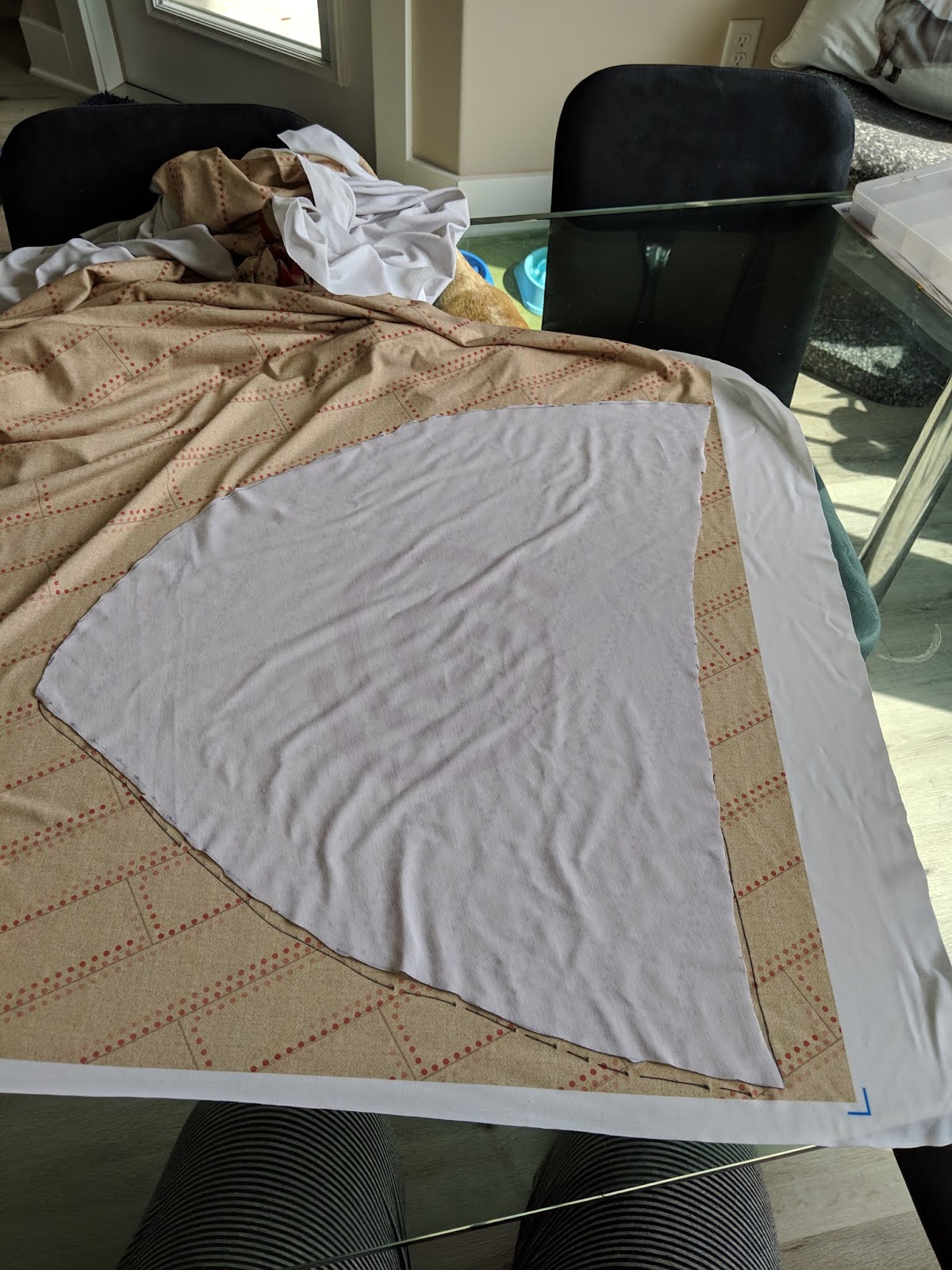
1 - Lay the fabric out on a flat surface with the spiral pattern centered. Imagine and then draw a large sail shape with the marker. Make it about half an inch in each direction larger than you need it, since you will be sewing seams on each side. 

2 - Use fabric scissors to cut along the sail shape you've drawn. The cuts don't have to be perfect, because you'll end up hiding the cut edges on the inside of the purse.

3 - Find another section of fabric with the spiral pattern and flatten it out with the spiral pattern centered again. Take your first cutout and lay it upside down so that the two faces of the pattern are together. This is to make a symmetrical copy. Trace around the edge of the upside down piece. 


4 - Use fabric scissors to cut along the sail shape you've traced.

5 - Lay the pieces together so that the faces are towards each other and you are seeing the white underside. Line up the edges and pin them. 


6 - Take the cotton cord, measure and cut one piece double the length of the top of the shape with a little extra slack. 


7 - Tie the two ends of the cord together and place along the knotted end on top of the fabric.

8 - For each side of the purse, wrap the top edge of the fabric around the cord and pin. 


9 - Sew the seams at the top of each piece holding the cord in place.


10 - Sew the other two edges of the fabrics together, just like you would if sewing a pillow. You sew them with their patterns facing each other so that when you're done, you'll flip them inside out and the seam (and messy cut edges) are on the inside, and the outside looks clean. Helpful tip: When you get to the end of the first edge and you want to turn the corner, make sure the needle is in the fabric (manually roll it if needed) and then lift the foot, adjust the fabric and then set the foot back down. This gives you a continuous thread and ensures you don't have any gaps. 


11 - Once both edges are sewn together and all pins are removed, flip the fabric inside out through the open edge. 


12 - To make the purse strap, cut a long straight strip of fabric, however long and thick as you'd like. Make sure to make it a little more than twice as thick as you want the final strap to be. The cut doesn't have to be perfect, since you'll end up hiding the cut edges on the inside again.


13 - Fold the strip of fabric in half and pin. Then sew along the open edge. 


14 - Flip the strip inside out. It will take some working from both ends. 


15 - Cut additional cord to run the length of the strip plus some additional slack.


16 - Run the cord through the strip to the other end so you have some cord handing out of each side. Helpful tip: You can use a permanent marker or pen with a clip on the cap to wrap some cord around it and then use the marker/pen to edge through the fabric strip. 


17 - Tie both sides of the cord in the fabric strip to the cord going around the rim of the purse. Make sure it's the length you want, and trim/adjust the cord and/or fabric strip or tie additional knots as needed to get the desired length.

18 - Once properly adjusted, sew the bottom of the strip on both sides to the rim of the purse. 


19 - Show off your handiwork! Feel free to post pictures on my facebook page at: https://www.facebook.com/deziwheel/ I'd love to see what you've done!  


Get the guide

Sign up with your email below to join my writing journey, and I'll instantly send a printable guide for this project straight to your inbox: 


Get inspired

Want to bring Disney into your home? Check out my book on Amazon Kindle! 

Design Hacks for Disney Themed Rooms