Showing posts with label Tokyo. Show all posts

Sunday, March 31, 2019

Japan Guide: Eating Out

Eating Out

Lots of restaurants will advertise if they have an English menu, and they'll offer it to you if they have one if they recognize you look foreign. If they don't, there's almost always lots of pictures, and you can just point.

No tipping, and taxes are usually included. Both of these are big bonuses in my book, I like
that these are the customs in Japan and wish that the US would adopt these practices.

Sometimes hosts will ask you if you want to sit in smoking or non-smoking sections of the restaurant.

If servers don't come to your table and you need to place your order, get more drink or pay your bill, it's normal to call them over. Use the phrase, "Sumimasen," which means excuse me, and they'll come right over.


Most restaurants are very specialized in a certain kind of food. For example, tatsu (fried) places will have mostly tatsu, and not sushi or ramen. If you want good ramen, you need to go to a ramen place. For a truly Japanese dish, I recommend
Partially eaten okonomiyaki
okonomiyaki, if you can find it. They refer to it as a savory pancake, but it's so much more than a pancake, with noodles and cabbage inside, and the delicious and distinctive okonomiyaki sauce they smother it in (along with mayonnaise).

My favorite dish, however, is yakiniku, and also a little bit difficult to find. I used to eat it at school when I studied at Hiroshima Shudo University, and it appealed to my limited palate because it is very simply beef and rice, but whatever magic they sauce it with, it's delicious. I found it also at a restaurant in Miyajima.


A suitable and quite delightful proxy can be more easily located at, of all places, a uniquely Japanese burger franchise
called MOS Burger, home of the yakiniku burger. Speaking of burgers, I also recommend eating McDonald's in Japan just once, if you have the chance, so you can experience that.

One note about sushi: when you go to sushi in America, much of the fish is cooked and has fun names like California roll or Dynamite roll. Most of the sushi in Japan, in our experience, is raw. Some may be broiled or seared but may not be fully cooked. I'd advise to keep you mind open, if you're going to try raw fish, what better place to do it than in Japan where they really know what they're doing?

As far as ice cream, sodas and desserts, there are lots of unique flavors that Westerners aren't generally used to, like bean curd. Fish-shaped Taiyaki is a delicious treat you can get at street vendors, especially if you can find chocolate filled ones. Teas and waters, too, especially in the vending machines
or convenience stores, have some wild flavors. My favorite was the orange flavored water, and Jaiman really enjoyed the apple flavored tea as well as the melon soda. 


More Japan Guide

Getting There / What To Bring 
Training It - The Best Way to Get Around in Japan (Trains) 
Where to Stay
Eating Out
Things To Do 

Key Phrases

Japan Guide: Where to Stay

Where to Stay - Tokyo

Capsule Hotels are great - read more about my experiences here:

Capsule Hotel - Brilliant or Terrifying?

Capsule Hotel: Bather Tested, Claustrophobic Approved!

Of major importance is to note that most capsule hotels are only for men, so if you are a woman or will be traveling with women, make sure to find accommodations that allow women. A lot of people have a visceral reaction to the idea of capsule hotels, but I would challenge you to at least try it for a night as part of your Japanese experience - you will likely be pleasantly surprised!

Whether or not you stay in a capsule hotel or a traditional hotel, location is also key in Japan. I would also recommend staying fairly close to the train stations, especially those for the JR line. You'll know they are JR line stations if you look for public transit directions on google and they have a line that starts with "J", like "JK" for example. This will allow you to easily access the rest of Tokyo
easily, and you won't have to drag your bags too far to get to your hotel.

The Akihabara District is popular with gamers and fans of nerdy things like Anime, Pokemon, etc. We really liked our hotel here, the Remm Akihabara hotel. It was right next to the station, near food and a convenience store, and easy to find.

The Shibuya District is the high fashion district, with artists on the streets just about every night, trying to be discovered, and infamous for its "Shibuya Scramble" - one of the busier pedestrian crossings you'll see.

Shinjuku is another vibrant area with lots of shopping and food.

I would just recommend that wherever you are looking, look for pictures to make sure you're comfortable with what you're getting. Rooms are very small typically. I prefer to use Travelocity to book hotels, it has treated me well. I don't care for hotel breakfasts here (usually fish or unappetizing sausages and seaweed wraps or whatever). We like picking up breakfast (and sometimes dessert or nightcaps) at local Family Marts or 7 Elevens, they're virtually everywhere and a lot of the food is labeled in English. Look for unique Kit Kat flavors there, too! There are also McDonald's and Burger Kings around, so breakfast is pretty easy.

Where to Stay - elsewhere

I want to put in a plug for one of the most amazing experiences we had in Japan that most people aren't really aware of. We stayed on the island of Miyajima,
just off the shore of Hiroshima. You'll take a ferry from Hiroshima to get there, and will immediately be greeted by the deer who often walk into the ferry station to look for snacks in newcomers' bags. We had booked a pretty neat room at Miyajima Grand Arimoto, and our room included a private onsen (hot spring bath). The food was incredible in Miyajima, and while it had some touristy parts of it, it felt like it catered to Japanese tourists rather than tourists from outside the country. Miyajima is one of my happiest places on this Earth, and I hope more people will get to experience its magic and beauty. Read more about my Miyajima experience here. 

More Japan Guide

Getting There / What To Bring 
Training It - The Best Way to Get Around in Japan (Trains) 
Where to Stay
Eating Out
Things To Do 

Key Phrases

Japan Guide: Tips for First-timers and Returning Visitors to Japan

I've recently returned from my third trip to Japan, and it has spurred a lot of conversation with colleagues, friends, and total strangers like Uber drivers and the girl at the DMV. For those who haven't been, Japan can seem like an "exotic" place to visit, but for Jaiman and I, it's as natural as any adventure. There are some really neat aspects of Japan that make it very friendly to tourists as well some aspects that are a little daunting to newcomers. After a number of these conversations, I thought I'd put together a semi-comprehensive guide to visiting Japan.

Embedded in this guide are tips for what to do and what to expect in certain situations. I believe knowing what to expect helps people feel more comfortable when confronted with something so completely different like a whole new culture. Here is a summary with links to each of the sections:

Getting There / What To Bring (below)
Training It - The Best Way to Get Around in Japan (Trains) - What to expect at the train station and how to prepare and navigate for using trains as your primary mode of transportation in Japan.
Where to Stay - What to look for in hotels.
Eating Out - No tipping, and taxes are usually included! And other tips for what to expect at Japanese restaurants.
Things To Do - My recommended Must-Dos as well as some other fun ideas for your itinerary.
Key Phrases - Don't Miss This Section! Most people in Japan are not great at English, so it is very helpful and respectful if you have some basic Japanese phrases under your belt when you go.

Bonus: Japan Is Weird (Different) and Confusing (Unfamiliar) and I Want to Go Back - Some quirks and our favorites from our previous trip are discussed here


Getting There

Narita is the bigger airport in Tokyo, but both Haneda and Narita are fine to fly into and out of. Most itineraries will go through Tokyo, even if you're going elsewhere in Japan. As such, I'd recommend flying to Tokyo and staying there for a few nights if your schedule permits, and then you can always take a bullet train to other parts of the main island instead of getting back on an airplane. If you plan to ride the shinkansen, or bullet train, I would recommend you look into the JR Pass for Visitors before you go, you can get a really good deal and save hundreds of dollars, but you have to buy it before you get to Japan.

Flights from the US are lengthy, at least 10 hours and up to 15 hours depending on where you're flying from. When you land, you'll be about 12 hours off from your previous timezone, so it's important to sleep a little but not the whole time on the plane. The best way to ward off jetlag is to stay up most of the arrival day, and then make sure you go to bed at a decent time the first night.

Many major airlines have personal screens with entertainment, and free alcohol for international flights. You'll also notice that announcements will be made in Japanese and English, and potentially Chinese or Korean as well. While checked luggage may be free for the international flights, I prefer to pack lightly (at least on the way there) so that I can limit myself to carry-ons. If you plan to do a
good amount of shopping, it may be a good idea to bring an empty collapsible bag to fill up with your goodies to bring home. Don't worry, though, if you forget, because you can find cheap bags for this purpose in Japan, too (Jaiman got a huge duffle bag for about $16 USD). 

What to Bring

Definitely bring plenty of Japanese cash (yen) to avoid costly ATM fees, you'll need cash at the train stations and at many restaurants, street vendors, vending machines, etc. Major credit cards (Visa, Master Card, Discover) are accepted at many places, but not all. Make sure you know which credit cards have foreign transaction fees. My Discover card doesn't have foreign transaction fees, for example, so I prefer using that when possible, but sometimes places don't take Discover, so then I'd have to use cash or another card and pay the small fee.

Umbrellas are a good idea generally, but they can be purchased pretty readily if you need one while you're out and about.

Bathing suits are a good idea if you plan to go to a public hot spring / onsen. Many are separate by gender and are only used in the nude, but some will have coed spaces for those with bathing suits.

Comfortable shoes are a must, it doesn't matter how little you expect to walk, you'll probably walk more than you expect. 


More Japan Guide

Getting There / What To Bring 
Training It - The Best Way to Get Around in Japan (Trains) 
Where to Stay
Eating Out
Things To Do 

Key Phrases

Thursday, March 28, 2019

Capsule Hotel: Bather Tested, Claustrophobic Approved!

Two years ago, my boyfriend, Jaiman, and I visited Japan together and accomplished a number of Life List goals, including sleeping in a capsule hotel for me. Jaiman is a bit claustrophobic so he opted out of the capsule hotel then. But after I told him about how wonderful my experience was (and you can read my glowing review here), he became more open to it. We recently returned to Japan for another visit, and this time, we made reservations for both of us at a capsule hotel. I chose a different one this time to put us in Akihabara, and in doing so, had very much a different experience (some positive and some negative). I thought I'd share a little bit here, to update my general recommendations around capsule hotels for visitors so you know what you may want to look for, and what could be useful for future developments as well.

First of all, most capsule hotels are for men only, so the selection for women are limited. As such, I can only visit and review a small portion of capsule hotels. The one I selected this time is called Glansit Akihabara Comfort Capsule Hotel. I was a bit bummed to learn that there was no restaurant on property, so after
checking in and putting our things away, we had to retrieve our shoes and head back out for dinner. It is worth noting, however, that there was a really good ramen place just next door that we really enjoyed. Both capsule hotels had a good Wifi signal and plenty of places to charge your phone and other devices.

As with my previous capsule hotel, shoes are removed right in the lobby and you wear slippers provided to you for the rest of your stay. The capsule hotel is
really set up to provide just about everything you need to stay over, even if you didn't intend to stay away from home that night. Meaning, they provide toiletries, pajamas and towels, and they had a vending machine in the lobby to buy fresh underwear (for men), socks, undershirts, etc.

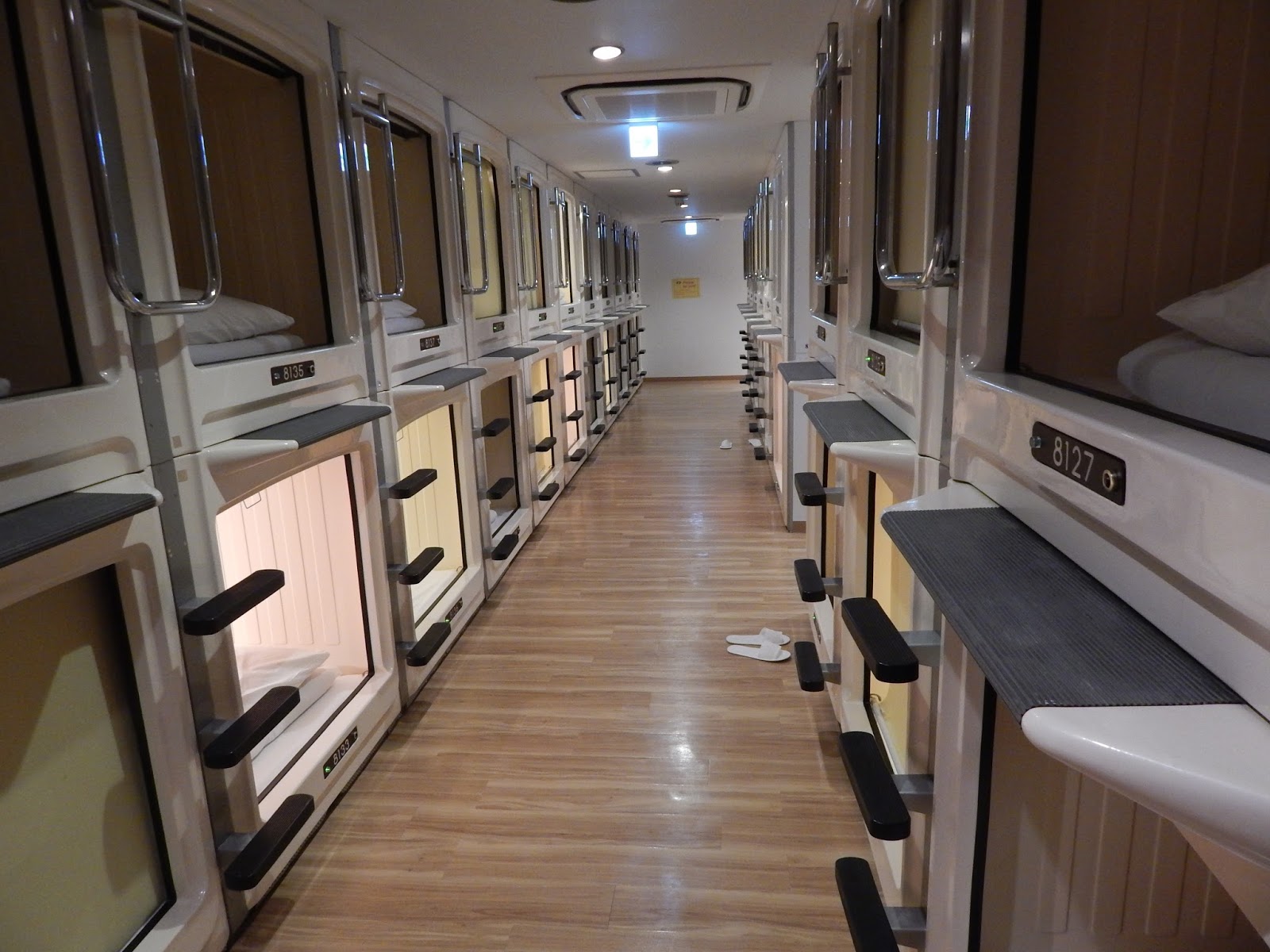
Further comparing this capsule hotel to my previous one, there were quite a few drawbacks from my perspective. The biggest I think was that the capsules
weren't very soundproof, so it was quite noisy as the woman in the capsule above mine moved around. I don't recall this being an issue at my previous hotel. The lounges were separated by gender (i.e., a male lounge and a female lounge on separate floors), which meant I couldn't hang out with Jaiman like I would have been able to at the previous hotel. This may be a plus for single travelers or same-gender groups, because you can perhaps be a bit more comfortable with your own gender. The showers/bath were on the same floors as the lounges, which meant in order to go bathe, I had to get into the elevator to change floors, which I found quite awkward. The good news is that the men's floors were all the bottom floors, so in theory, the men shouldn't be in the elevator going up to the women's floors, but it did happen once while I was there. Also, the shower stalls were open, which I don't think was the case at my previous capsule hotel. The toilets were on the same floor as the capsules, but the stalls were very small and there wasn't a hand washing station with soap on the floor, just a sink with water. The changing room / locker room was also very small, such that if I was changing, there wasn't enough clearance for another woman to go around me. In general, everything was just very, very tight, which obviously does not need to be the case based on my previous capsule hotel experience.
The pillows here were, I believe, more "traditional Japanese", meaning not the conventional pillows an American might expect - I'm not sure how to explain them but they are more firm and filled with something like rice, versus soft and fluffy. I would lean on calling this a negative, but the pillows weren't actually uncomfortable, so I'm a bit on the fence on them.
On the plus side of this capsule hotel, the pajamas provided to me by the hotel actually fit, which is especially impressive since I'm larger than the average Japanese woman and often have difficulties finding things that fit. Also, a big plus was that the pull down shade on the capsule was much darker / more effective than my previous hotel, making the capsule darker when my lights were out. The TV in this capsule was much larger, and came with headphones to listen to it. A bonus from my perspective was the large soaking tub that was constantly replenished with perfectly comfortably hot water. I don't believe it was a hot spring or onsen, I believe it was tap water, giving the bath the name of sento. Either way, I am a big fan of baths, and taking a nice hot bath after my shower really hit the spot. Now, for what it's worth, Jaiman had a very positive experience at this capsule hotel. He is 6'2" and I thought he might be challenged with the length of the capsule, but he said he was fine, although if he really tried, he could hit the curtain with his toes. Even with his claustrophobia, he had no issues or concerns sleeping in the capsule. One additional bonus was that the back of this capsule was super cushy and comfortable to lean up against, without even needing a pillow or anything to lean on.

All in all, I still think capsule hotels are a really inexpensive and practical way to stay in Tokyo, especially if you're traveling with a group or by yourself. It's also lots of fun to post pictures of your capsule for the sole purpose of shocking your facebook friends and family. If I've sufficiently encouraged you to visit a capsule hotel on your next trip to Japan, feel free to use the below table that summarizes my experiences at the two capsule hotels to decide which one you want to visit, or use these notes to look for a different hotel.


Glansit Akihabara Shinjuku Kuyakushomae
Lounge Separate by gender, free coffee / tea drinks Combined genders, has restaurant and beer
Bath Small toilet stalls, open shower stalls on separate floor, sento soaking tub Spacious and provided privacy, on same floor as capsules
Capsules Shade was more effective in creating darkness, not very soundproof, big TVs with headphones Shade let a lot of light into the capsule, more soundproof
Amenities PJs fit well, only one laundry machine Multiple laundry machines, beer vending machine, PJs were too small
Bedding Firm pillows Comfy bedding / pillows
Price $48 per night $33 per night
Book https://www.travelocity.com/Tokyo-Hotels-GLANSIT-AKIHABARA-COMFORT-CAPSULE-HOTEL.h20218454.Hotel-Information?langid=1033 https://www.travelocity.com/Tokyo-Hotels-Shinjuku-Kuyakusho-Mae-Capsule-Hotel.h3020494.Hotel-Information?langid=1033 


Here are some additional pictures of Glansit Akihabara:


Thursday, May 19, 2016

Capsule Hotel - Brilliant or Terrifying?

A lot of people said I was crazy when I told them I'd be staying in a capsule hotel as part of my life list achieving trip to Japan. Now that I've done it, I can authoritatively say that it is awesome, and incredibly practical, and not weird or scary at all. Where else can you walk around with no shoes, in your pjs, and have draft beer served to you for less than $2 a glass? Add to that the fact that you can do your laundry in this place and have a reasonably priced meal (my meal was 600 yen, which is less than $6) served to you while watching TV, charging your phone and/or working on your laptop. And when you're done lounging around, you tuck yourself into your very own cozy little bed. 

Consider this: if you're staying in a hotel with friends or several adult family members, you're sharing one bathroom and maybe sharing beds. You fight over the few plugs, and maybe someone wants to watch TV while someone else wants quiet to read. Not to call anyone out or anything, but my sister has to fall asleep with the TV on, but that's too much stimulation for me so I usually have to wait until she's asleep so I can turn it off, or for the sleep timer to kill it (unless I'm completely exhausted, in which case I could fall asleep at a rock concert). I think capsule hotels are ideal for this type of travel, because there are dozens of (really high tech) toilets and showers to share, you have a general hang out place to eat, unwind and recharge, and your own private space for watching TV or reading or whatever else.

I think capsules are only weird because they are novel; the idea of sleeping in something like a drawer conjures notions of coffins and dead bodies at the morgue. But not once did I feel like I was in a tight enclosure or suffocating or anything like that. I didn't panic when I woke up, and I didn't smack into a wall or bang my head on the ceiling. Even though the pjs provided didn't fit, I felt perfectly sized for the capsule; if anything, I felt I had more room than needed (at least in width).

One of the few drawbacks I see are that you don't have a permanent place to lay your things out. Even if you are staying multiple nights, your capsule assignment changes everyday. In retrospect, that's not necessarily a bad thing; it forces you to pack lightly and stay organized. But still, I know I like to spread out when I travel, so I consider it a drawback.


I did think it was a little odd that the hallway lights were never turned off or even dimmed, and the curtain in the capsule helped significantly, but did not make the capsule completely dark.  Maybe that's by design, I can't say for sure, but if you need absolute dark to sleep, you may have trouble in a capsule.

For those who are taller than me, a capsule may be a little cramped. When I was laying down stretched out, my feet could graze the dividing curtain. I generally sleep in my side with my legs bent, so it wasn't a problem for me. But I would definitely caution anyone taller than 5' 8", especially if you sleep on your back.


The only major drawback I see is that there is no space to cuddle up with a significant other. The chairs in the lounge are all individual seats, and even if you could squeeze into a cuddly position, it wouldn't feel appropriate. I imagine a world where capsule hotels are the norm, and in that world, there would be specialized floors, like double-wide capsules on coed floors, and that would solve the problem instantly.

All in all, I think if I were traveling with a group of friends, and capsule hotels were an option, I would strongly advocate for them over traditional hotels. They are super practical, very inexpensive, and I am absolutely in love with the casual lounge concept. I can honestly say I didn't really want to leave, and I would recommend a stay at my capsule hotel to anyone who is not afraid of challenging the norm.

If I've persuaded you to try out capsule hotels, please note that most capsule hotels are for men only.  The one I found that had just one floor for women is called Shinjuku Kuyakushomae Capsule Hotel.  Perhaps because there is just one floor for women, it seemed to sell out in advance, so be sure to book early if you are a woman.  The hotel had free cancellation on Travelocity, so it doesn't hurt to book it that way even if you're not perfectly clear on your travel plans, as long as you cancel with two days notice if your plans don't work out. 


2019 Update: Comparing and Contrasting Capsule Hotels


Here are some additional pictures from the capsule hotel!