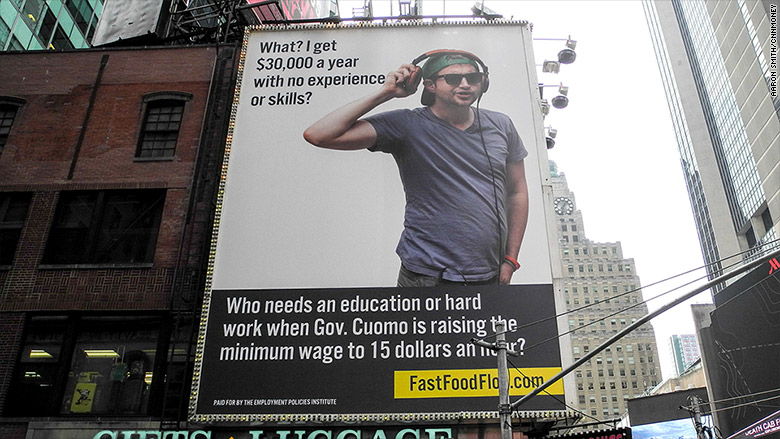
I am always a little shocked and appalled when I watch politicians wave around some economic policy that sounds good on the surface as long as you don't consider the implications like it's the silver bullet that is going to fix a crisis that  has actually been improved within a historical context. So naturally, I had a gut check reaction when I heard that all three of the Democratic nominees were blindly supportive of this $15 minimum wage.
Free market economists argue that the ideal minimum wage is $0, and that the market should be free to determine what the appropriate wage is based on supply and demand of labor. Maybe that is extreme, assuming that some people would not fight hard enough for a wage they deserve, and that large employers may take advantage of desperate underprivileged populations. But the opposite of no minimum wage has even more dire consequences. Corrupt employers already pay below minimum wage under the table, so raising the minimum wage to impossibly high levels for unskilled workers would only
lead to more undocumented workers and a black market for labor. In addition, automation of low-skilled jobs is only kept at bay by the cost, but again, increasing the minimum wage to a level that is no longer economical for companies would encourage non-corrupt companies to simply automate more of the work or remove the need for work whatsoever. Fortune's article suggests one such solution: "Hotels may reduce their tendency to automatically clean the rooms of their guests, and may charge extra for doing so." There are plenty of other sound, economically-based arguments again the $15 wage, here are a couple articles for reference.
All that being said, I want to address a very different aspect of this argument. Imagine a world where you could make the same amount with an associates degree as if you didn't graduate high school at all. How many young people are going to strive for a degree at all with that lack of incentive? Then picture this: you go to the store the day after Thanksgiving for Black Friday shopping, and instead of your usual 1.5 hour wait, you are waiting 10 hours to buy that 50% off game system for your oldest son because every customer has to go through a slow, glitchy self-checkout and the store cannot afford seasonal help to assist customers. Every police officer on duty is escorting customers out of these stores to ensure they are not shot or robbed of their hard-earned presents, meanwhile there are no officers available to attend to that car that slid off the road due to ice, or to check on the house that is being broken into by an armed robber. What's worse, your teenage daughter has nothing to put on her resume because she was never able to work until she got her bachelor's degree, since stores and restaurants couldn't afford to higher high school or college kids.
I believe that young people deserve the right to work for single digit wages. They deserve the opportunity to get seasonal jobs for while school is out to earn some extra money for the holidays or to save up for a car. They deserve to learn what it takes to earn money, and to learn the value of the dollar.
Proponents of the $15 minimum wage are assuming that people making minimum wage are supporting whole families on that, and therefore they need more money to do so. While the premise may have some truth to it, I think the $15 minimum wage is exactly the WRONG answer to this problem. What we should be looking to do instead is to figure out why people are trying to support a family without having gotten any useful education or employable skills, how we can reverse this problem, and how we can prepare young people to earn more than minimum wage before they have a family. For example, programmers make well above minimum wage, and there are literally dozens of free resources already available online that can help individuals learn how to program. What's more, there is a shortage of programmers and they are only  going to be in increasingly high demand as technology becomes more integrated into everything we have and do.
In my estimation, it would be far less detrimental to the economy to provide an educational stimulus to allow minimum wage adults to take a paid sabbatical to study programming so that adults that truly need a higher wage to find better paying jobs. Even this seems like an example of wasteful government spending, since these programs are already free and accessible by anyone with a computer connected to the Internet (which is available for free at the library, if nothing else). But, this makes more sense to me than the idea of raising the minimum wage to unsustainable levels that will inevitably result in another recession.
And certainly, programming isn't the only field that could benefit from such an
initiative. I believe that everyone has potential to excel at something, so if people need more than $8 or $10 per hour, they should seek the kind of help and resources that will get them to the wage they need to support themselves and their families, in whatever field they are passionate about and/or will excel at. If we start handing out $15 per hour paychecks (or any amount that ensures support for a full family) to people flipping burgers or bagging groceries, what incentives will they have to contribute their deeper, more profound gifts to society?
Before I belabor my point too much, I will conclude that we should maintain service and labor jobs at wages that make sense for the kind of work being performed, and that we should make the abundant and accessible resources to improve one's financial situation more prevalent. By doing so, we will lift up the nation and raise the entire productivity of the country, rather than dumbing down our society and pretending that we're spreading wealth to the poor while actually robbing our neediest of the opportunity to work at all.
Publishing here from a previous facebook post from Aug 30, 2010.
For our supply chain class this week, we had two articles about
lines and waiting in them. More and more, consumers are looking for an
experience, not just a product or service in isolation. Managing
customers' wait times is not enough, because they have expectations
and perceptions about their wait that need to be managed. As I was reading, I was
thinking of some of my own examples, and thought, just in case anyone
else finds this interesting, I would post them here. The information in
the articles and some of the ideas posted here might be great
benchmarks or best practices for anyone starting their own company,
too.
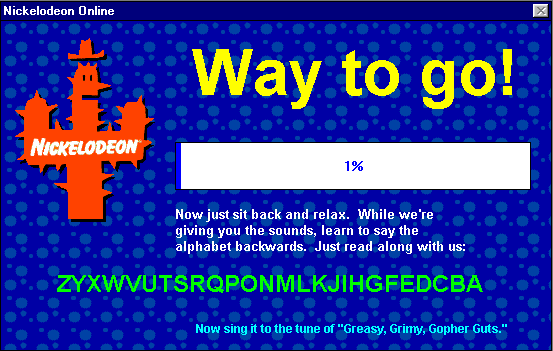
- Back in the day
when you had to wait for something to load on your computer for hours,
the Nickelodeon channel on AOL encouraged us to
 learn to say the
alphabet backwards, and then provided the alphabet backwards for us to
practice. It was an idle, somewhat unrelated activity, but I eventually
took their advice and learned the alphabet backwards one day while
waiting for something to load, and can now recite it to this day. Other
ideas would be learning Pi to the 25th digit, memorizing zip codes or
area codes for various parts of the state/country, learning measurement
conversions (I always forget those), or maybe just interesting facts.
These could be used in certain queuing systems with real people just as
much as on the computer.
learn to say the
alphabet backwards, and then provided the alphabet backwards for us to
practice. It was an idle, somewhat unrelated activity, but I eventually
took their advice and learned the alphabet backwards one day while
waiting for something to load, and can now recite it to this day. Other
ideas would be learning Pi to the 25th digit, memorizing zip codes or
area codes for various parts of the state/country, learning measurement
conversions (I always forget those), or maybe just interesting facts.
These could be used in certain queuing systems with real people just as
much as on the computer.
- Check out lines can entertain you by
the variety of gum, magazines and other various items. By perusing
these items in line, you take your mind off, even temporarily, the wait
and how long you're waiting and the causes for the wait. There is also
the added benefit that the store can gain lots of extra sales from these
last-minute impulse buys.
- Massage Envy offers water to their
waiting customers - similar to the bar at a restaurant concept - and
also suggests that maybe they need to use the restroom before going into
their massage appointment. There are also lots of things to buy, from
scented candles to therapeutic lotions related to pain relief - similar
to check out lines.
 Portillo's Hot Dogs would send employees
outside to the drive-thru lane on a busy day to take orders from people
before their cars physically reached the speaker. Even before they came
to me, I felt better about seeing him/her out there for several
reasons. First, I could see progress, even though my car was barely
moving, he/she was speedily coming down the line. Second, seeing
his/her progress allowed me to predict when he/she would reach my car
(eliminating uncertain waits). Third, once I gave my order, I was in
process and no longer pre-process - this also creates commitment where
some people might bail after waiting so long.
Portillo's Hot Dogs would send employees
outside to the drive-thru lane on a busy day to take orders from people
before their cars physically reached the speaker. Even before they came
to me, I felt better about seeing him/her out there for several
reasons. First, I could see progress, even though my car was barely
moving, he/she was speedily coming down the line. Second, seeing
his/her progress allowed me to predict when he/she would reach my car
(eliminating uncertain waits). Third, once I gave my order, I was in
process and no longer pre-process - this also creates commitment where
some people might bail after waiting so long.- Oregano's has you
put your name in like most restaurants, and gives you the option of
sitting at the bar like many restaurants. In addition, however, there
is plenty of seating provided for the waiting area, and they sometimes
walk around with sample pieces of pizza for their waiting customers to
try. I love this for lots of reasons, partly just because it helps pass
the time, but its also like free advertising for their new pizzas or to
get people to try something they wouldn't otherwise.
- Like
Oregano's, samples are key to keeping customer satisfaction up at Beyond
Bread in Tucson. The sample bread is placed somewhere between the door
and the cashiers, depending on how long the ordering line is. If its
long, the samples will be available near the door so you can start
munching while in line. If the line is short or nonexistent, many
customers order first and then grab a piece of bread to munch on while
they wait for their food. Drinks are also an important way many
restaurants keep you entertained and happy while waiting on food -
especially when you get your drink from the fountain yourself… this
fills the time up so your idle wait time is shorter.
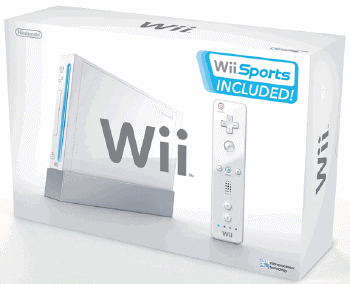
 Waiting for
the first ever Nintendo Wii's at Walmart - not only was this a
community feeling because we were in line for several hours (Paul and I
got there at 6 for a midnight release), but the store handled it really
well by periodically coming out and letting us know how many Wii's were
available and that only one Wii was allowed per person, so it lowered
our anxiety about getting one. Of course, there were obnoxious, naive
passersby who killed the mood by shouting to us that Wii's would be
widely available by the end of the month - little did they know it would
take years for Nintendo to catch up to demand. Around 11 pm (an hour
before they could sell us the Wii's), the store manager came out and
handed us each a numbered ticket. Without this ticket, nobody would be
able to buy a Wii. So then we had a guarantee to a Wii, and were then
allowed to get dinner or browse the store for an hour. Furthermore, we
retained our place in line with the number, so the first people in line
were the first to receive and pay for their Wii. An added service was
that security guards escorted every customer out of the store and to
their cars just in case someone tried to steal the precious systems from
us.
Waiting for
the first ever Nintendo Wii's at Walmart - not only was this a
community feeling because we were in line for several hours (Paul and I
got there at 6 for a midnight release), but the store handled it really
well by periodically coming out and letting us know how many Wii's were
available and that only one Wii was allowed per person, so it lowered
our anxiety about getting one. Of course, there were obnoxious, naive
passersby who killed the mood by shouting to us that Wii's would be
widely available by the end of the month - little did they know it would
take years for Nintendo to catch up to demand. Around 11 pm (an hour
before they could sell us the Wii's), the store manager came out and
handed us each a numbered ticket. Without this ticket, nobody would be
able to buy a Wii. So then we had a guarantee to a Wii, and were then
allowed to get dinner or browse the store for an hour. Furthermore, we
retained our place in line with the number, so the first people in line
were the first to receive and pay for their Wii. An added service was
that security guards escorted every customer out of the store and to
their cars just in case someone tried to steal the precious systems from
us. - Fry's Electronics - like the Whole Foods in NY we read
about, Fry's has a bank-style check out with dozens of cashier stations,
red and green lights to denote working or available, and an employee at
the front of the line to direct customers to the next available check
out.

Emissions Testing - they have a website to show you a
visual video feed of the cars in line as well as the most current
prediction of time spent waiting. At the center itself, they also show
you the prediction of time spent waiting. This made the wait more
bearable - until I saw the average time increasing by one minute every
minute. There were also signs to read to prepare you for the test -
this also sped up the process I imagine - but it also gave me something
to do and decreased anxiety of whether or not I had everything I
needed. One addition I would recommend: add that they take cash or
credit card and how much the test would be so people can be prepared for
this (I had anxiety about it going in). An even better addition would
be the take a number approach. You could take a number with an
anticipated time to return, and then go grab dinner, etc., instead of
waiting in line. Alternatively, there could be two lines, one to wait
in and one to take a number in. That would be slick! BTW if anyone is
looking for a supply chain project, I think this would be awesome!
 has actually been improved within a historical context. So naturally, I had a gut check reaction when I heard that all three of the Democratic nominees were blindly supportive of this $15 minimum wage.
 going to be in increasingly high demand as technology becomes more integrated into everything we have and do.