Friday, June 20, 2014

The Tools of an Anal Retentive Organization Freak

It's been a while, admittedly, since someone has asked me, "How do you do it all?", but I think that's probably because I haven't entered any new circles recently, and the people in my life have just gotten used to me.  I am also not quite so go-go-go right now, because I actually like where I work so I'm not quite as driven to get away from it (what a difference!!).  Regardless, I still have some obsessive organizational qualities about me that I need to manage, and I was inspired to catalog a number of them for you today in hopes of helping others who either need such tools to balance their anal retentive style, or who need such tools because they lack motivation to stay organized.  I will qualify this post with the fact that this is not nearly an exhaustive list of all awesome tools, nor do these tools reflect the best or only tool in their category.  There may be other ways of achieving these functions, and perhaps even better ways of doing so; in short, these are simply the tools that I have experience with and like. 

EverNote
I am a convert from previously using Microsoft's OneNote, but both are very solid tools for writing, keeping and organizing notes.  I think where these tools lose people is that they associate note-taking with school, and if they're not in school, they assume they don't take notes.  So what is a note?  A note can be a to-do list, a journal entry or blog draft, a means of tracking performance qualitatively, a visual that you need to refer to only once every so often, and so much more.  But before I dive into all the many kinds of notes, I want to talk briefly about why I like EverNote.  EverNote (as does OneNote) allows me to group my notes into "Notebooks", so I know where to look for a specific note that I'm looking for later on.  It also magically Syncs between computers and even my SmartPhone.  The syncing was the initial differentiator for me; at the time of my conversion to Evernote, OneNote didn't sync with everything else just yet, although I believe that has changed now.  So this means that I can write a note at work, and without emailing or saving to a flash drive or anything like that, my note is magically on my phone and on my laptop at home.  This seems simple and straightforward enough, but its a very powerful thing to not have to think or worry about saving or sending this kind of data.  For example, I keep a checklist in Evernote of work tasks, and sometimes I'll remember something I need to do at 3 am.  Rather than getting up and going to my computer to send an email to myself, or taking the risk of forgetting it, I can open up my list on my phone next to me in bed, add that item to my list, and go back to sleep. 

So, what is a note?  I will differentiate lists with visual elements to them and lists with more textual information here, and put forth that To Do Lists, Shopping Lists (especially for something broad like Christmas shopping), and Favorite Quotes lists are all ideal candidates to be put into a note.  I have a dedicated Notebook called Lists, and each note is a separate list.  OneNote and Evernote have a checkbox capability, which is especially nice for those of who like to feel the victory of checking a box after accomplishing something (hey, it's the little things that count)!  I also have lists of goals, notes for house guests (on numerous occassions I have offered up my home to visitors and this list helps me make them feel welcome and ensures they understand the nuances of my poor old house), interview questions and good examples to use in response (great for job seekers to review right before an interview) and a Watch/Read/Listen to list. 

Another kind of note is a reference.  Perhaps the best way to explain this is with some examples.  When I first moved into my (fixer-upper, old, ugly, broken) house, I spent a good deal of time mapping out the electrical network: for each circuit, what light switches, which fixtures, which outlets are on each circuit.  I used some generic architecture software to draw a floorplan of my house and label each fixture and outlet so that I could visually see where each circuit goes.  Now, I certainly don't need this every day, so if it had been a simple file (which I suppose it was at some point), I probably would have lost it with a new computer or just in the shuffle of moving files around.  But because its in a note under my Home Notebook, I can quickly pull it up on my phone or computer whenever I need to shut off the electricity to a certain appliance or outlet.  Another example of a reference I used a lot during my job search was job descriptions.  I was applying to about 5 jobs per week, which doesn't sound like too much to keep track of, except when you consider that it might take four to eight weeks to get a call back.  Suddenly, I would get a call from a recruiter wanting to ask me more about my experience as it relates to job x, and I would have to either make something up, admit that I don't know which job they were referring to, or fumble about trying to find what the hell job I applied to.  And it's such an easy fix!  I simply created a new dedicated Notebook called Job Descriptions (duh), and everytime I applied to a job, I would just copy the entire job description and paste it into the note.  Usually, the title of the job is the first thing on the page, and Evernote adopts the first line of a note as the title unless you specify a title, so I literally didn't have to type in anything!  Just copy, paste. 

I like to write my blog posts in my Evernote, rather than drafting them in the blog site itself.  I'm wary of writing inside websites because there are 100 things that could go wrong and cause you to lose all your work.  With a note application like Evernote, the work is saved automatically from time to time, and not just to the machine I'm on, but to my very own little cloud.  That's a nice feature when you are constantly at risk of a phone dying or computer crashing.  Plus, it does a better job of spell checking than most websites.  An added benefit to the always-on-the-go person is the fact that you can dictate into your smartphone, so that if you have a brilliant idea but you're an hour away from home, you don't have to wait until you get home to get your idea down on (virtual) paper.  Also, by keeping journal entries and blog posts in my notebook, I can easily search them if I'm looking for a specific reference. 

Brilliant Ideas and Gift Ideas are two other notebooks I maintain.  I am terrible at buying gifts for people as Christmas and birthdays approach, but throughout the year I tend to think of great ideas for gifts (usually when I least need ideas).  So keeping a record of gift ideas helps me when I actually need them.  Likewise, I have dozens of (what I consider) brilliant ideas to make the world a better place, but I don't have the means, position or resources to pursue all of them.  So I feel better having at least documented them for reference later, if I happen to be in a position or have the means of accomplishing them.  I also come back to them when I need inspiration; they help recharge my mojo so to speak. 

For anyone who is employed in a rigorous professional job, I have a recommendation for you that I've only recently implemented myself in the last couple years: Performance and Potential notes, sometimes called Praise Piles.  I keep track of every email that gives me an earnest recognition of a job well done at work.  In addition, I keep notes on activities that demonstrate the skills and attributes set forth in the goals and performance evaluations of my company.  So when it comes time to for my performance evaluation, I can back my ratings up, or make a case for my manager to increase my ratings, with concrete examples from the previous year.  I cannot say this actually won me anything in my last job, but there's a reason I left that job that may or may not be related to that.  I am optimistic it will help in my new job. 

Alright, I think this blog is already getting a bit long, so I'll wrap this section up with a list of other "notes" I keep, and by saying that pretty much anything wordy that you'd want to track may qualify as a "note" that you'd want to enter and store in a notebook program like Evernote for future reference. 

Other notes:

  • Shared notebooks for start-ups or teams to load research, draft copy, updates, etc.
  • My favorite massage therapists (and my least favorite ones) so I hopefully know what I'm getting into when I book a massage
  • Packing checklist for upcoming trips (i.e. bring sand castle mold to Hawaii)
  • Places to go / activities to do for upcoming or unscheduled (dream) trips
  • Taxes - to document mileage to/from doctors, charitable donations (non-monetary), etc.
  • Measurements of windows and other physical attributes of my house for shopping purposes
  • Reimbursable expenses (with pictures of receipts)
  • Drug prescriptions (with pictures)
  • Restaurant orders for my honey (in case I'm surprising him with something like donuts or Chipotle)


Pinterest

If you don't know what Pinterest is, they describe themselves as a virtual pinboard.  It's a very broad, loose definition and I don't think the world has grasped its novelty and usefulness just yet.  In fact, I wrote a whole post about the various uses (and sins) of Pinterest (and thus, do not feel the need to exhaust every opportunity I see again here).  I mention it after Evernote because they can be used for some of the same things.  For example, before I started using Pinterest, I maintained a Watch/Read/Listen to list in Evernote.  But most such items can be graphically represented, and thus, look a lot more exciting as virtual pins on a Pinterest board.  So the differentiation is whether the "list" you are starting or keeping is more textual or more graphical - that should determine whether Pinterest is better or Evernote.  Also, if most items on your list can be associated with links, Pinterest is a better option, because they will preserve the links for you as well as the graphical imagery and your specific text.  Other boards I recommend people create / maintain in Pinterest include:
local places to try (i.e. restaurants, museums, etc.)
Things to do in ______ (i.e. Vegas, so that you have it ready for your next Vegas trip)
Wish List (this is the best way to keep a public wish list that I've found)
Gift Ideas (keep this board secret so nobody knows what you're getting them)


Hootsuite

I've probably raved about Hootsuite in half a dozen posts all over the web, but I think its worthwhile to reiterate here.  Hootsuite is a great way to manage your social media presence, whether we're talking a company, volunteer organization, part of a softball league, or just you (and even better when you're dealing with a combination or all of the above)! 

For example, I might be traveling or business on Father's Day, having celebrated with my father on an earlier occasion, but still want to post something to thank my father and all fathers.  So I can use Hootsuite to load up my message (and associated photo), schedule it for Father's Day morning, and have it post without having to remember to log in or try to find internet service while I'm on the go.  This ability to schedule posts is awesome when I have something I think is hilarious to share at 3 am, because I can jot it down in Hootsuite, schedule it, and rake in all the likes and favorites and retweets once it gets posted at a time when more people are awake.  "Autoschedule" allows me to space out my posts if I am browsing and finding lots of interesting articles, videos, and tidbits, rather than bombarding my followers with a bunch of posts in rapid succession.  Last spring I converted a lot of my old VHS tapes of various high school performances to digital video clips, and rather than throwing them all up on the web at the same time, I spaced them out to weekly intervals.  So all summer my followers would be surprised and delighted (as was I) when some random old video popped up.  I scheduled my favorite to post on my birthday.  Slightly more sinister, if you're at work and you don't want your co-worker friends to know you were browsing the internet at work, you can schedule your post for whatever time you should be getting home so that it looks like you just saw it and shared it at that time. 

Besides the scheduling feature, Hootsuite has a very functional (albeit not as pretty) dashboard type of feel that allows you to view multiple "streams" of your choosing, which can be searches on specific topics or events going on as well as certain users' posts, etc.  Thus, in one screen, I can see who is talking about #NASA, what is going on at #PhxCC (Phoenix ComiCon), and what the tweeters I follow are posting.  Unlike in Twitter and facebook themselves, Hootsuite stores these searches so everytime I log in I can see them without having to recreate the searches every time. 


Microsoft Excel

Yes, I am considered an Excel guru, so this should be no surprise to some of you.  Most people will not use Excel nearly as much as I do, but there are a few reasons why most people should use it.  Banks and credit card companies as well as financial software claim to have good budget tools, but I prefer to do it myself in Excel.  I maintain a Cash Flow worksheet that is actually very simply but is the most effective tool I've found to help me identify where I have cash flow issues as well as to budget how much I can pay off student loans and car loan, as well as how much I have that could be invested and how much extra fun money I have.  It starts with the current amount in my bank account and lists all of the upcoming expenditures impacting my bank account for roughly the next 18 months.  I go in there every other week or so and delete the line items that have been taken out of my bank account, and update the current balance and any new expenditures I've learned of.  Then I tweak the payments on loans and credit cards until I'm happy with my cash flow status, and then I go into each of those websites and schedule the payments accordingly.  I also have clever notes about interest rate and how long it will take me to pay down each debt based on the payments, which motivates me to pay down the highest interest rate items more instead of giving myself more fun money.  If you stay on top of this, you should never have a late fee, overdraft issue, trouble making minimum payments, and yet you need to keep a very minimal balance in your bank account.  I  run a very tight ship this way, making the most of my income to get to a debt-free situation asap. 

Excel is inherently good at anything calculation based.  Thus, another application any person might use it for would be planning a vacation.  I recently used Excel to minimize costs for a trip to Cedar Point in Ohio.  I had about five airports we could have flown into, so I listed each of those as an option, and then wrote next to them the cost of each flight.  Then I looked up rental car prices from each airport and listed those, then added in estimated fuel usage and associated cost.  Another option was staying right at the park, flying into the nearest airport and then taking a taxi, so I enumerated and calculated that option.  That helped me determine the best way to get there.  Then there was the matter of deciding upon which hotel to stay at and whether or not to buy the 2-day passes from the hotel.  I listed out all the options with and without the ticket packages, with and without breakfast and added in the tickets to the options with no tickets, and added the estimated cost of breakfast to the deals without breakfast included.  I couldn't imagine doing all this manipulating and calculating in any other tool or by hand.  Excel is it for me! 


onStar

I love technology, and when I got my fancy new Chevrolet Volt a few years ago, it came with five years of onStar.  I didn't think I would use it much, and its true that I haven't called them more than three or four times in the past several years.  But what I didn't realize until I had it was that with the onStar app I can send destinations to my car's navigation system from my phone.  So before I leave for a new place, I send it to my car and then my car picks it up shortly after I turn it on.  This is cool, and also a big time saver.  Likewise, if I'm at a computer, I can use Mapquest to send the destination to my car (although the retrieval takes a few additional steps).  onStar also gives me a somewhat detailed report every month, which the data analyst part of me enjoys dissecting from time to time. 


Waze

I stumbled upon Waze while stuck in a traffic jam and using Google Maps to figure out what was going on.  Waze is primarily a commuting app that gives you traffic conditions, warns you of police and obstacles in the road, and provides a live ETA to you and whomever you wish to share it with.  The data primarily comes from users sharing their information, tagging where accidents, police or broken down cars are, etc., and automatically transmitting their speed through the app.  Since I am now driving in the carpool lane, I don't usually turn it on because I don't want my data to give an overly optimistic picture of what traffic conditions are like for the poor saps in the regular traffic. But it is incredibly useful for my honey to transmit his ETA to me when we're meeting somewhere or running tight on a schedule.  Once he sends me the link to his data, I can track his progress and see how far he is, which helps the psycho anal retentive person in me to make decisions, and calms the tightly-wound worst-case-scenario beliefs.  I wish I had had this app for previous relationships, it actually might have solved some problems and made life just a little better.  An added perk is that if you are meeting someone at a place that is new/different to you or to them, you can transmit your current location.  So, I parked on the south side of a large complex, and transmitted my location so that my honey could park in the same area as me.  Clever, right?  It's a pretty neat little app, not something I use all the time but helpful when I do use it. 


Retractable charge cord

What would this list be with only virtual tools?  One of the most useful things I carry in my purse is a little USB charger that retracts into a small cylndrical shape and never gets tangled as a result.  Paired with a USB to electrical outlet plug, it allows me to charge with a computer (or other device with USB) or with an electrical outlet anywhere I go.  And its compact enough that its really not a bother to carry with me at all times. 


TripIt

I don't know of an app that is so simple and so helpful as this one.  Of course, it's used for a very specific purpose, so it's not something I'm in all the time, but when I need it, it's awesome.  I first heard about TripIt from LinkedIn a long time ago, before smartphones, and it was basically a website you could create an account with and link with your LinkedIn I guess just to brag about your previous and future trips, and also to see when/where you will be in the same vicinity as someone else.  Both a little cool in their own respects, but TripIt didn't mean much until I had a smartphone with the TripIt app.  Suddenly, I was able to carry my itinerary in a clean, simple form, with me on my phone all time.  Populating the itinerary is super easy, too, because you simply take your confirmation emails from your airline, hotel, rental car, or restaurant reservation and forward them to a generic TripIt email address from your email address that you used to sign up.  Within seconds, your itinerary is populated with dates, times, addresses, confirmation numbers, costs, and any other pertinent information TripIt identifies from the email.  Sharing trips is just as easy, you add a traveler, and that person also gets the itinerary on their phone.  So while we're traveling, I can open my TripIt app to get directions or check the time of our reservation at a specific venue.  Never again will I miss my flight while hanging out on the beach of Cancun because I got the departure time mixed up with the arrival time - (and yes that did happen once) - never again! 


Designated places

Organizing things virtually is one of my favorite things to do, but sometimes we get physical things, like tickets to a game or show, and they are so easy to lose track of!  So there are certain things that I have designated places for, and it requires so habit-forming to remember each of those places.  As an example, I have a board in my hallway where I put "spent" ticket stubs up with tape just for fun, and there's a little clip on the left side, so I slide in any tickets for upcoming events into that clip, thus I always know where to look for them when it's time to go.  Admittedly, I could probably use more of these "designated places" because things like my purse, incoming mail, and my boyfriend's backpack are always landing somewhere different every day. 


Google Alerts

I don't spend a lot of time browsing the internet or looking up the same things over and over again.  So when there is a topic I want to keep track of, or an eminent event that hasn't been scheduled, I will set up a Google Alert about it, so that I am emailed with information about that topic based on the frequency and relevancy that I choose.  For example, I was anticipating the Harmon Hotel in Las Vegas to be imploded, so I started having articles with the words "implode", "Harmon" and "Vegas" sent to me.  My hope was that as soon as a date was set, I would book a room at a nearby hotel overlooking the Harmon so that I could have a great view of the show!  Unfortunately, it looks like the Harmon is going to be peacefully disassembled over a very long period of time.  A more successful example is following the news of the Chevrolet Volt and Nissan Leaf when they first came out; I knew before anyone else when there was controversy, potential recalls, and how sales were doing.  I also got to see a lot of information about other electric cars because they articles would reference the Volt or the Leaf. 

I think it's especially important to have Google Alerts about yourself; that is, I have an alert for "Laura Winger" and "Laura Lee Winger" so that I can see what comes up about me on the interwebs.  You might be surprised what comes up about you.  Some of the top hits for me in the past have been my Japanese e-portfolio I did while studying in Hiroshima, the articles I wrote while working for ASU's school newspaper, The State Press, and fabric designs I've created that are really popular.  There is another woman who comes up from time to time by the same name, and she also went to engineering school, so I could see a potential employer getting us confused.  But as long as she doesn't become a drug dealer or open a porn website, I'm okay with her name intertwining with mine. 


Ceiling Studies

Okay, I made that term up, but stick with me because this may be helpful for you.  A while back, I signed up for a trip to China with my kenpo dojo.  We were going to Beijing, Shanghai, and Dengfeng, where the Shaolin Temple is.  Not being very good at geography growing up, I thought it would be a good idea to at least understand where those cities were on a map and in relation to one another.  So I google a map of China, and then googled a simple clipart of China.  Using the map as a guide, I marked the major cities in big, bold lettering, and then printed the graphic on a few sheets of paper.  I took the prints and taped them to the ceiling over my bed.  As the sun started coming up in the morning, I wasn't quite awake enough to get up, and didn't even want to play with my phone yet, but I idly eyed the map of China.  Every morning I'd wake up and see that map, and eventually, it got ingrained in my head, without any real effort to learn it.  After coming back from my second trip to China, the one I took with my MBA class, I had learned of up-and-coming cities in China that were of interest to me, so I added those to my graphic and put that above my bed until I knew them as well.  I did the same thing with India when I started meeting a lot of people from India and wanted to be more knowledgeable when they told me what part of India they were from. 

There are a lot of things that can be made into visuals that can aid our learning.  As adults, we may not be taking classes all the time, but there are certainly things that we want to learn, and if those things can be made into a large visual like I've described here, perhaps they can be learned with minimal effort just by staring at the ceiling each morning. 

Sunday, June 8, 2014

Lessons for a Beginner in 3D Printing (from a Beginner in 3D Printing)

They say that the hardest part is getting started.  I couldn't disagree more.  The hardest part, of accomplishing anything, is perseverance.  When things break, when something goes wrong, when the outcome is not a desirable result, it is disappointing.  And disappointment defeats the energy and motivation we had at the start.  It can be so difficult to pick up the pieces (quite literally in the case of 3D printing), and start over.  So yes, the first step is to get started, but there are bigger challenges to face than that.  

I recently spent some time at my local TechShop giving 3D printing a whirl for the first time.  I am happy to say that I did complete two small projects, but it was not without trials and errors.  I had taken their mandatory class a couple months before, so I was a little foggy.  As I got started, I successfully fed the plastic into the machine based on my experience in the class; we all had to practice doing that and I was comfortable with the steps.  What I was not comfortable with was creating a design from scratch (for us un-savvy creatures, this may require a different class), and the "how to make it go" part.  A lot of time in the class was spent on the software, moving the object, turning it, etc., and there wasn't a lot of time spent on the printing aspect.  Even still, I would recommend taking a class at TechShop or similar before trying to 3D print somewhere or at home, even if its not required in your circumstance.  It may be well worth a trip to one of the cities that has a TechShop, just to get a foundation in the use of 3D printers before setting out on your own.  Here are some tips to prevent silly missteps and issues for a first-timer trying out 3D printing.  

1 - Use an SD card that is formatted for the 3D printer.  
Unfortunately I learned this lesson the hard way.  My print job was about a fifth of the way through when the machine pulled down the table and retracted the printer head, with an error on the screen referencing a problem with the SD card.  So the strange thing was that it had started printing just fine, but stopped while working.  The error did say that if this was the first time it had occurred, to try again, but I didn't want to take my chances.  I used the SD card provided in the kit, and it worked seamlessly from then on.

2 - Make sure you know which file format the 3D printer uses.  
I had notes referring to an older model which said to use .s3g file format.  For the model I was facing (MakerBot Replicator 2), I needed to use .x3g.  What was frustrating about this seemingly easy problem to fix was that, assuming I had the design in the right format, I started troubleshooting other things like maybe the machine wasn't ready yet, or maybe it wasn't feeding properly.  Maybe, I thought, it just needed to process the design for a while.  I wasted so much time on this!  Then, when I looked at the SD card in the kit, I saw that all the files from previous users were .x3g, and quickly resolved that issue.  

3 - Feedback is pretty much immediate.
This is one thing I was unsure about, and I wish someone had just told me straight up, if the machine doesn't appear to be working, then its not.  When you click "Build from SD Card" and there's no designs listed, it means it doesn't recognize any files.  When you identify a file to print, it starts doing something right away (parts move and the screen indicates its warming up).  When the plastic isn't sticking to the table, the design starts coming apart.  There is very little user wait time involved in 3D printing; it is either working or waiting on you 98% of the time.  

4 - Don't try to do too much at once.
The first design I tried to tackle had four pieces to it, so I thought I was very clever to combine the pieces onto one file and arrange them so that they wouldn't touch or overlap.  But to my dismay, I had a number of issues during the print, and that meant that all four of the pieces had to be started over again each time I had an issue.  It would have been much smarter for me to start with one piece, deal with the issue, start it again, deal with that issue, and so on, then to have several broken, unfinished pieces because of just a couple problems.

5 - Prying completed objects off the table is tough.
I think I suffer from an unusually weak level of strength in my fingers and hands.  As such, I may have used the tools more than most.  But there are tools to aid in this endeavor, and I've learned time and time again that the right tool for the job makes the job much easier.  The plastic is pretty durable (depending on the design, of course), too, so I didn't stretch or hurt any of my designs as I pried them off.  I think this is another "good to know" point, because first-timers might be worried about breaking things.  

6 - The plastic coming out of the nozzle is not always easy to see.
I had a small panic attack during one of my earlier attempts to print, because I didn't see any plastic really coming out.  When I went to the back of the machine, the reel didn't appear to be spinning.  I got worried that the printer head was just going through the motions and not actually producing layers of plastic.  As it turned out, it was working just fine, I just couldn't really see it until it was done.  This technology is working at such a small scale that it's not always going to be clear to the naked eye that progress is being made, especially for flatter designs.  The first layer of plastic is generally pretty obvious, because its so different from the table below it.  But as layers get poured on, it becomes difficult to see the difference between a fresh layer and the layer below it, and thus, looks like nothing is happening in the short term.  So my advice is to trust the machine and let it do its job.  

7 - Use previews before printing.

I think this is especially important for beginners because it allows us to solidify our understanding of shells, fill, supports and rafts.  Being able to see what the design will actually print before printing it, and playing with the different settings to see how that changes the preview, is very advantageous for tactile-style learners like myself.  It also allows for a time estimation, so you know how long you can expect the machine to spend printing.  
8 - Ask questions.
This may go without saying in a lot of learning experiences, but I think it is especially important when working with a machine.  If something is going wrong, ask a staff member to help.  The TechShop staff were very helpful in solving some of the earlier problems I had in which the machine itself was acting up. 

9 - Keep trying.
It can be frustrating, especially if the problems you're having are because of the machine or something outside of your control.  But I truly believe that 3D printing is going to be really important in the future, and chances are, if you're reading this or trying it out for yourself, you probably agree.  So it is worth it to persevere and don't give up.  Take a break if you need to, or walk away for a little while (not while its printing of course), or call a friend to stand by you.  Do whatever it takes to keep going until you have a success under your belt.  It gets much easier once you know you can do it!  

And with that, here are my successes!  


Designs from http://www.thingiverse.com/thing:49080 and http://www.thingiverse.com/thing:27739.

Wednesday, April 30, 2014

On Mantras

I recently noticed a theme in my life that I hadn't really realized touched on so many aspects of living - mantras.  Now mind you, I am very action- and results-oriented, so words alone don't mean much to me.  But my realization was that some words drive action and results for me that others don't - and that makes those words, or sequences of words, very powerful.  My hope is that by sharing these very personal insights, others can use them or a variation of them to inspire and motivate themselves.

Last weekend I took the APICS Train-the-Trainer class again; I had not taken it in several years and I have grown as a presenter, instructor and public speaker substantially since that first class.  But I recalled the key to getting over my nerves in public speaking, and it was a mantra I had learned in that class:  
"The audience wants to see you succeed."  
There was more to the idea, to be sure.  Nobody in the audience wants to see a speaker flounder, break under pressure, stutter, talk too fast, or do anything else that distracts from the message.  Indeed, the audience comes to hear a no-name speaker generally for one reason - the message, or content, that speaker has promised.  Thus, it is our jobs as speakers, instructors, lecturers, whatever we may be, to deliver the content or message in the best way we are able to.  This idea, somehow had the power to break me of my shaking, stuttering, talking too fast, and sweating, that accompanied giving a speech or lecture.  I have grown into a comfortable, casual instructor.  It is especially easy when I know the material thoroughly, but for material I am less confident in, rehearsing can prepare me to be just as comfortable in front of the audience.  The envision-everyone-in-their-underpants trick never worked for me, and no other public speaking trick I've heard of has helped, but hearing and believing that the audience wants me to succeed did, and still does. 

My second mantra is what finally kicked my butt into gear to start exercising and eating healthy again.  I let myself get into a habit of eating whatever I enjoyed, and stress eating, and not exercising as much as I should because I had so many other things to do.  I realized a while back that getting back in shape would never work if I didn't commit myself 100% of the time to that goal; some goals can be worked on sporadically, but health is not a goal like that.  Dieting and exercising needs to be priority number one, or it is not going to succeed at all.  But even after those realizations, I had a hard time getting myself committed - I knew it took commitment to do it consistently, but I just couldn't find the motivation within me to commit.  Finally, I had had enough.  It was a little over a month ago that I declared to myself (and not really anyone else except those impacted by my commitment), that I was going to turn this thing around.  The mantra I have found to help me stay committed is this: 
"There is nothing more important to do today than to get healthy."  

Sometimes I phrase it into questions: "What is the most important thing I need to do today?  Is it (whatever else I'm considering doing)?  Or getting healthy?"  Invariably, unless I have a specific appointment I need to attend to, when I ask myself these questions, I end up at the gym or working out in some way.  It also keeps me motivated while I'm at the gym.  When I find myself thinking about all the other things I want to accomplish that evening, I start thinking about cutting my workout short.  But then I stop and ask myself what's more important, and I stay on track with my workout. 

I think it's important to note that some quotes or mantras don't work for some people.  For example, I've had this quote on my closet door for years, in hopes of inspiring me to work out every morning: 
"This is not about instant gratification. You have to work hard for it, sweat for it, give up sleeping in." - Lauren Fessenden  
Unfortunately, despite its fantastic placement next to my alarm clock, it has done nearly nothing for me.  It seems compelling to me, and yet, it has compelled me to do very little.  Maybe it will inspire others as I thought it would inspire me.  For some reason I can't put my finger on, it just didn't work on me. 

It's been a while since I've needed this next mantra, but it was very effective.  It was for when I was single, and feeling like I'd forever be single.  I simply looked at a couple comprised of individuals I see nothing desirable in, and say, "If THEY can find someone to love them, then surely there is a match out there for me."  Kind of mean, but you know, it's better than just saying I'll never find anyone.  It kept me looking for love when it seemed impossible to find love.  It didn't get me all the way to my current relationship, but it got me mostly there, and luck, and good friends got me the rest of the way.  Now, of course, I don't need the mantra because I have found a love who makes me so overwhelmingly happy it's hard to believe he's real.

Music has also been very instrumental in pushing me forward throughout my life.  I don't recall exactly which song it was, but I remember having one song that was current at the time be my motivation to finish my calculus homework for an entire semester.  I borrow from musicals quite extensively; Wicked's "Dancing Through Life" when I need to de-stress and enjoy life more, and Pippin's "Extraordinary" when I am feeling trapped. 


Now, to reward you for sticking with me so far, I'm going to tell you a very strange personal secret.  I don't remember when or how it started, but for as long as I can remember, I've had this mantra running through my head: "I make over $100,000 a year."  I don't, in reality, and I never have thus far.  But it is certainly a goal of mine.  The weird thing is it might run through my head 40 times a day.  When I'm walking, when I'm in the elevator, when I'm brushing my teeth, when I'm applying deodorant, when I'm showering, it plays over and over again in my head.  It bothers me a little bit that I can't make it stop; I'm not sure if it makes me feel like I'm greedy, or too narrowly-focused, or what it might say about me psychologically.  Someday, I'm sure, I'll achieve that goal, and maybe that voice will be quiet.  Or maybe it will pick up a different mantra.  Or maybe, it will simply increase the quota.  I don't know.  All I know is that it drives me, everyday, to do my job to the best of my ability (or seek out a new job that I can do to the best of my ability if I don't see my job going anywhere), so that I may one day be the kind of person to make $100,000 a year. 

I can't think of any other real mantras that I've used, but now that I am more aware of their power, I may create new ones or realize more that I've forgotten here.  I am also curious to know what mantras other people have used to help them through something.

Monday, March 10, 2014

A New Voting System: Issues, Not Parties


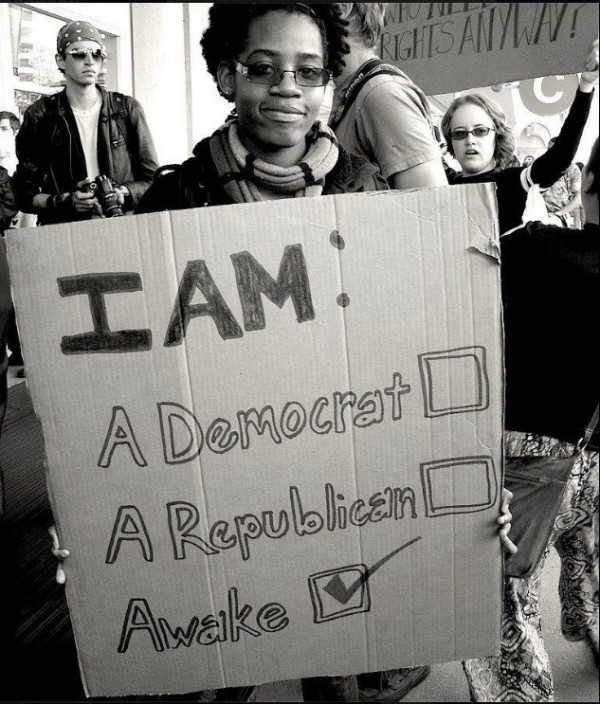
What was hardest for me in last election was that there was hardly any meat to chew.  Very few issues were addressed by the campaigns and in the debates, and those that were addressed were not addressed directly or properly.  I used to vote based on the issues I'm most concerned about, and where each candidate stood on those issues.  I had next to nothing to go on this time around.  Instead of having to pick from the lesser of two (or more) evils, I think we should do away with the party system entirely.  Instead, Americans should be presented a list of issues, and the voting would have three parts: (1) rank the issues that are most important to each person, (2) vote what action or direction should be taken on each issue, and (3) decide who you want to put in charge.  Then the leaders would be tasked with executing America's decisions, based on the most highly ranked issues, regardless of their own personal beliefs or partisan stances.  The politicians can be graded on whether or not they accomplished the goals America asked them to work on, and thus potentially earn re-election if successful.  That would be a true Democracy!

Every election year, there's talk of whether or not the electoral college is still relevant.  On the one hand, it is an antiquated system created when we just didn't have the ability to get accurate information to all parts of the country.  On the other hand, a popular vote alone might lead to under-representation.  I think this debate hints at something much greater and deeper: that the voting scheme we use today was made for the days when people were uneducated and uninformed.  Now, many more Americans have access to decent education and higher education, and we have information overload through the Internet and other media.  If a business model was made for the 18th century and isn't working today, you'd do away with it.  Why would we run our country any different? 

So often, I find that I full-heartedly agree with a candidate on several issues, but am completely disgusted with their stances on others.  Do I vote for that candidate, or find someone more palatable overall?  We should not have to make these kinds of split-hair decisions.  It gets worse, too.  Often, the candidates I could agree with most easily overall have weaker stances on each issue, and are third party candidates.   So then I have to decide if I want to vote for a candidate not all that likely to win, because he/she does not have an R or a D after his/her name.  On the off chance he/she does win, we will have to deal with the consequences of a perhaps less-experienced politician with inadequate defenses.


Maybe now is not the right time to completely revamp our political system, with the fiscal cliff looming and unemployment painfully high.  But if and when we get out of this financial mess, I'd like to see a group of politicians from both sides get together to develop and propose how a government in the 21st century could run.  We need fresh ideas to change the course of this country, not infighting and bazillion dollar campaigns.  Scrap tradition and disregard the nuances and tactics our founders established; imagine how a newly founded country in these times could be built and structured.  I'm not saying do away with the values or our rights, just think out of the box to look for new ways to preserve and protect our values and rights.  The good news is, creativity is a strength of America, and we have a wealth of intelligent people that could envision a new democratic process and make it happen. 

Friday, March 7, 2014

Pizza Delivery Supply Chain Improvement: The World's First Culinary 3PL

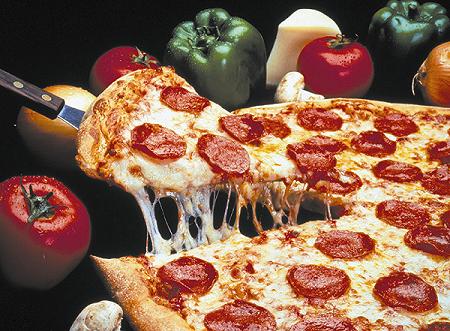
Don't ask me what made me think of this, I really don't know.  But somewhere between reducing capacity concerns at a liquid hand soap co-packer and refilling my cup of water, I got the whiff of a ridiculous idea for fast pizza delivery - or maybe it was the pizza being pushed by me as I made my way back from the water cooler.  Whatever it was, I think I'm on to something, or at least, its amusing to think about.

First, some background for non-supply-chain people.  The products you buy in stores are considered make-to-stock products.  Make-to-stock supply chain models are best suited for products that are low in value, like commodity items, have long shelf lives and have long lead times on the raw materials or manufacturing processes (or both).  Products that are high in value, like fancy computers and cars, are often make-to-order rather than make-to-stock.  Products with very short lead times and short shelf lives, like pizza or sandwiches, are generally make-to-order as well.  Make-to-stock supply chains require demand forecasting (and forecasts are almost never correct, they can be too high or too low), production planning (which either makes too much or too little, depending on the forecast and lot size factors), and materials planning which can wreck havoc on an otherwise perfectly planned production plan if the materials are not available.  When too much is produced and not sold, it becomes inventory which carries a cost.  When too little is produced, customers get upset and service levels tank.  It is easy to see why supply chain folks love make-to-order, because there is much less risk involved; you generally get payment up front, you have firm orders from real customers instead of forecasts, and all you have to do is produce it.  

Manufacturing companies also have a lot of logistics problems to work through on both sides of their operations: getting the raw materials or components needed to make what they make, and getting their finished products out the customers.  That is where 3PLs often come in.  3PL stands for third party logistics provider, and they are a unique kind of company that specializes in those logistical nightmares that manufacturing companies tend to struggle with.  My own experience with 3PLs has proven gains in efficiency, inventory accuracy, and service to our production lines and to our customers.  

So now that we have our basics, let's get back to my blasphemous or radically innovative idea I came to write about.  I started wondering what would happen if there was a 3PL managing pizza delivery.  On the one hand, sales forecasts are more accurate the more aggregated they are, so by removing the luxury of large warehouses, a 3PL might seem impractical.  On the other hand, lean methodologies tell us that a lot size of as low as 1 can still be efficient if the processes around it support lean principles.  

Let's imagine a densely populated neighborhood which orders on average 25 pizzas for dinner per night:  6 cheese pizzas, 13 pepperoni pizzas, 4 sausage pizzas and 2 special order pizzas.  Let's say the standard deviation is 1 pizza in each category except pepperoni, where the standard deviation is 3 pizzas.  The orders are placed between the hours of 5:30 pm and 8 pm and are normally distributed.  Would it be possible to set up a micro-delivery station in that neighborhood and other neighborhoods like it, where the pizzas could be made based on a forecasting system and delivered within minutes of the order, without losing too much freshness?  Imagine Jimmy John's delivery speed applied to pizza - if quality and freshness were comparable, it would blow away the pizza delivery market!  

It wouldn't be that hard, assuming, of course, that the demand is steady enough to warrant such a setup and and high enough to be profitable.  Some pizzas would be discarded at the end of each night (taken home by the delivery boys as a bonus), and special orders would still take a little bit longer.  But even special orders could be semi-baked the time the order comes in; if the order is for a pepperoni and sausage pizza, just throw some sausage on a semi-baked pepperoni pizza, right? In fact, I could imagine these little micro-franchises could be run by a person living in the neighborhood, and the pizza could be delivered by bike rather than car.  A teenager could do it after school, or a stay-at-home mom could run the dinner business when her husband comes home.  The possibilities are pretty neat when you make it so tiny anyone can do it.  And if there's no separate facility, there's no overhead.  Just materials (cardboard boxes) and ingredients, which pay for themselves when the customers pay for their pizza.  The only upfront cost would be a commercial oven, assuming that the conventional ovens at home are not large enough to support even this kind of demand.

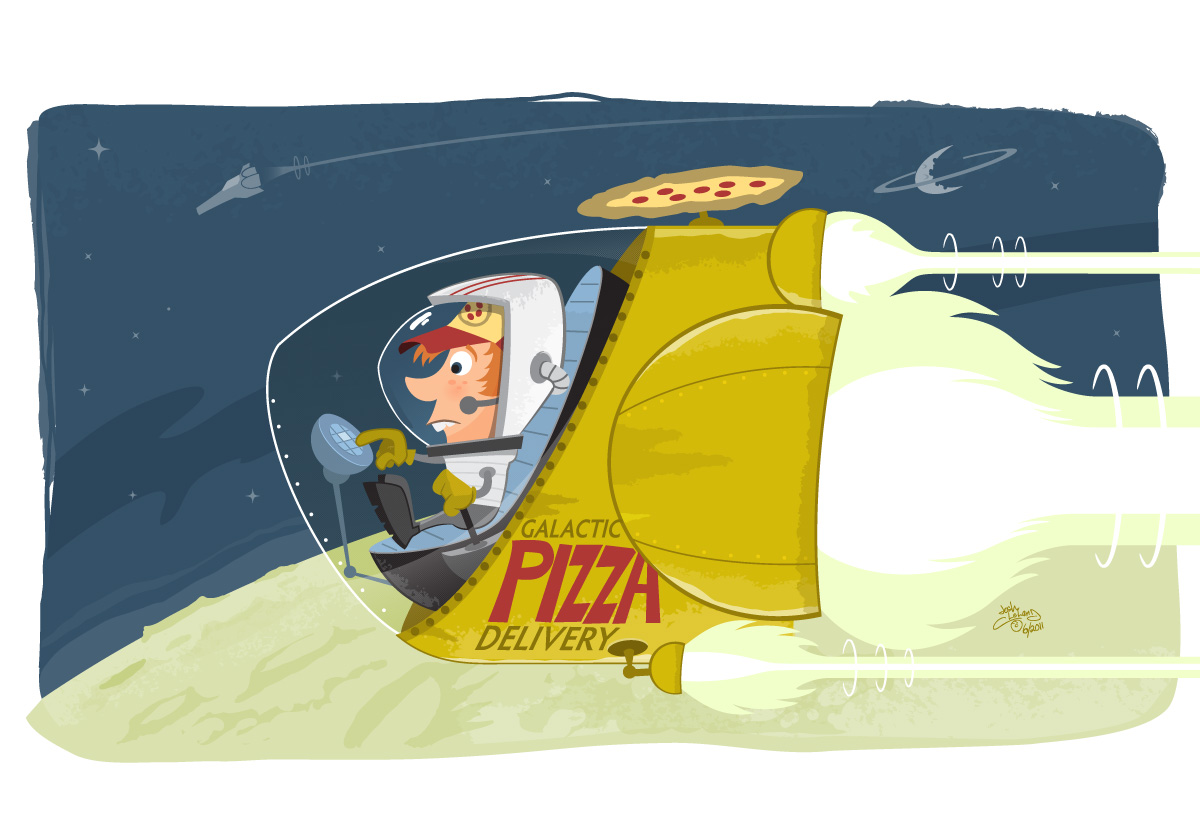
I have another twist, too.  I believe the very near future will include self-driving, autonomous vehicles in the marketplace.  Now, pizza delivery boys are not known to drive the nicest of cars, but let's imagine if the company provided the vehicles in order to support their business model.  With an autonomous delivery vehicle, an oven a mini-kitchen can be installed, and the delivery boy can be your cook as well.  He literally would let the vehicle drive him around as orders pop up (there would have to be some algorithm to deploy delivery boys based on location and availability, not unlike a taxi service today) and he would prepare the pizza on the way there.  When it finishes cooking, he boxes it up and brings it to your doorstep.  Now THAT'S fresh pizza!

So, until we have self-driving cars with pizza ovens in them (and the legislation to allow autonomous cars to be driven without the driver being attentive), I suppose the only issue is whether or not a neighborhood or small geographic area could have the volume and reliability of demand to support such a business.  Validating it prior to opening up shop could be difficult, as there are a lot of different pizza delivery companies, who are not likely to share their data with you.  I suppose you could set up cameras and watch for pizzas to be delivered; the good news is that its pretty obvious how many pizzas are being delivered visually.  In addition, the value proposition of impossibly quick pizza delivery is different than regular pizza deliveries.  In fact, it could increase demand for pizza delivery.  Borrowing a model I've heard for other startups, one way to validate it would be to set up a website to take orders, and when the orders come in, apologize to your would-be customers for not being able to deliver, and offer them a chance to sign up to find out when you actually are open.  This seems like it could turn people off though, and I would be afraid of the damage it would do.  Unless, of course, you did it in a different but similar geographic region then the one you plan to actually open up shop in.  Alternatively, coupons for future purchases might alleviate some of the "burned" feeling of your customers.  
 

Perhaps a good way to start is by making a few pizzas tonight and open up a preliminary shop (not yet equipped with commercial ovens), but limit the ordering process on the website to only take the first few orders with the 5 minute delivery time, and the rest to promise a more reasonable delivery time.  You'll know pretty quickly what your demand looks like.  You could even get friends and family who live nearby to pitch in their help for the first few opening nights in order to keep as many 5-minute delivery times as possible.  
 

That's about as far as I got.  I'm not all that interested in being in food service myself, but I think its an interesting proposition for someone looking to start perhaps the world's first culinary 3PL.  Anyone hungry yet?


Thursday, February 27, 2014

Be Dauntless: Facing My Fears

I am completely absorbed in the fantasy world of Divergent right now. And as I do with all things in which I'm absorbed, I started drawing parallels to my own life.

I imagine that most real life people would have a hard time choosing one of the imaginary factions in the fictional world of Divergent. I personally would be torn between the Dauntless and the Erudite. Erudite appeals to my enjoyment of having good, intellectual conversations, but that seems like it would be draining to have to do it nonstop. Dauntless just seems like fun, if not a little crazy.

SPOILER ALERT: Beatrice's faction choice and initiation In the book, the main character, Tris, goes through initiation and has to face her fears in a simulation. In my day to day activities, I'm not usually suffocated by crows or kidnapped by faceless men, but I do have to do things like talk on the phone for work.

I'm not embarrassed. I have anxiety about talking on the phone. I hate answering phone numbers I don't recognize. I hate calling people I'm not good friends with. And I am terrible at ending conversations - that is perhaps the strangest part of all. I can face my fears and answer the phone. I can answer the questions the caller asks of me. I can call other people (although I prefer to do it when my co-workers are away from their desks or pre-occupied so they can't listen to me as easily). And I imagine that I can end the conversation politely and professionally. But sometimes it seems to catch the other person offguard, and their alarm turns into panic for me.

This is what happened today. I thought it was better to chat with a co-worker in another part of the country about some questions I had, rather than email her and lose the inflection and personal touch. So while the person who trained me was away from her desk, and the colleagues in my row were chatting with other people, I picked up the phone and dialed.

My co-worker answered and we exchanged pleasantries. So far so good. I had written my questions down so I knew what to say, and I followed that script. I even typed in the answers to reinforce my memory, because in panic-y moments as this I tend to have no memory

Once my questions were done, I tried wrapping it up by saying that that information would help me, and thanking her for it. She said she was looking forward to my update (which we had previously exchanged an email about).

Then I said, "Okay, I'll talk to you later," maybe a little too quickly. She responded with something like, "Oh - okay. Good bye." She sounded stunned, like I had said something crazy. I don't know what I did wrong, except maybe speaking too fast. But it obviously bothered me enough to compare it to a fear, as if I was being tested like Tris was.

That got me thinking about what my fear landscape would look like. It wouldn't be anything physically traumatic like suffocating or being too high off the ground. It'd be mental. I'd have to answer a series of phone calls from unknown numbers. I'd have to eat a sandwich in a windy sand dune. Okay, maybe I'd have one where someone was breaking into my house, and I couldn't find them, because I'm always paranoid about sounds when I'm home alone. And I'm sure there'd have to be one scenario with bugs creeping up my legs. But other than that, I'm not really sure. I'm not afraid of jumping off a bridge or drowning in the ocean or of small spaces. I had no traumatizing beatings as a child to rehash, or deep-seeded fear that my family will die because of me. I think I am a bit of a thrillseeker, and I'm more rational and logical than emotional concerning most things. Research tells us most people are afraid of public speaking, but I've faced that fear and am largely over it. While in the Onsen in Japan, I was liberated from the nervousness that comes from being naked in front of people, because the Japanese women didn't even try to hide their stares. I've been comfortable being naked ever since: in tanning booths, in massages, in front of doctors.

SPOILER ALERT: Four's origins I supposed that makes me like Tobias in the book. I have four fears, while most people have 10 to 15. Is that accurate? Or is it because the kids in the book are still young, not having had time to face all their fears yet, and I'm nearly double their age. I suppose if I assume public speaking and nudity were fears I had when I was 16, that gives me at least 6 fears.

SPOILER ALERT: Tris' fear landscape I'll endulge myself to go a little into some criticism of the book. Tobias' fear landscape had four unique fears represented. It was clear in each scenario what the fear was. But in Tris' fear landscape, most of the scenarios can be tied back to a single fear: lack of control. And really, I may not be totally cognizant of my own fear in this respect, because I imagine I'd struggle a bit with those scenarios too. But still, if she had seven fears scenarios, but six of them were merely the same fear played out differently, then really, she's a prodigy with only two fears. Maybe her parent one was different, so call it three fears. But then, she should in theory be over the one with Tobias, so its back down to two. That's half of Tobias' highly-acclaimed four. Maybe we'll find out later that her Divergence causes her fears to be duplicated or something like that, but it just seems unfair. She's braver and smarter than she gives herself credit for, and she should be recognized as such.

Anyways, fear is not something we talk about a lot. In fact, my oldest sister and I went 20 years probably without realizing that we shared the same anxiety about phone calls. Yet they probably shape our lives more than we consciously realize. For me, being called too often by the some telemarketer or even professional contact irritates me. I typically avoid picnics and activities that involve sitting outside, for fear of bugs crawling onto me. I am not a fan of eating outside in general, even if its not near sand, because dirt in my sandwich has the same effect on me.

On the other hand, when overcoming a fear is important to me, like public speaking, I've made choices that lead to me facing my fears, in order to diminish them. Public speaking being my primary example. The Onsen example was not so much a choice as something I was flung into and permanently changed as a result, which is okay too.

The question then becomes, what fears do I still have that I want to diminish? I got stuck here, because I'm not sure I really care enough about any of the other fears. I am confident and courageous in the most important aspects of my life, I think. And on the other side of the coin, having the humility of a few fears might be good for my overbearing pride.

If anything, my phone anxiety could use some work. Breaking it down a little bit, I suppose my inclination to make phone calls when other people aren't listening or are pre-occupied means I'm afraid of sounding stupid or unprofessional. The reason I don't like answering phone calls is because I may not be prepared for the questions being asked. Also, I think I just don't like being interrupted. I like being in control of my schedule, of how my time is spent and what my priorities are. When someone calls me, that appears to me as an assumption that what they're calling about it more important than what I'm working on. And maybe they're right, but usually they're wrong. I have the same feeling about Instant Messages at work - and that annoys me even more I think because it loses the justification of wanting to hear voice inflection. If its truly a quick question that the other person would generally be able to answer off the top of their heads, I think that's an appropriate use of IM. But IMing me or calling me to tell me you sent an email, unacceptable. Should it be okay? Or are people just really that bad at communications etiquette?

But I digress... I'm not sure what bothers me while I'm on the call. It seems like I should be comfortable. Maybe I'm worried I'm taking too much of their time. I don't know what it is, but its easy for me to get flustered. Interestingly enough, conference calls are a whole different scenario for me - I'm comfortable on conference calls, like I am with public speaking. They fit in the same category for me. Maybe its just one-on-one interaction I don't like, like its confrontational (which I know I've always disliked). I think that must be it - I see one-on-one phone conversations as confrontations, and I shirk away from confrontations. So how does one get better at confrontations? Clearly, just doing more of them hasn't seemed to improve my ability.

I remember a revelation I had when I was learning to become an instructor, it stuck with me all these years when I think about public speaking or when I'm advising someone else on public speaking. It was that the audience wants you to succeed. I guess we naturally assume that everyone is waiting for us to fail, and that makes us nervous. I relaxed and became much more confident and comfortable once I told myself that my students wanted me to succeed -that nobody in the room wants to see me get flustered or panicked. So, perhaps I can apply that to confrontations. I need a mantra - like, they are seeking me out because I'm an expert - to help me relax. I'm not sure that's the right one, but something along those lines should work. Maybe it's they want to help me succeed. That wouldn't have been true in my last job, but much more likely to be true here. Certainly, I had a very negative person I had to work with my first job, Rhona, and she did everything she could to make sure I didn't succeed. That wouldn't have worked with her. With someone like Rhona, I would have to tell myself that I am smarter than her, or something like that. Maybe I need a combination of those - I'm smart so I will succeed, and maybe this person can help.

Well, it's not catchy. But I'll give it a go. I'm smart so I will succeed, and maybe you can help.